Shopping Cart




The Essential Dive Watch Maintenance Guide: Keeping Your Squale or Davosa Ocean-
By :
F. Nagy -
Categories :
Interesting Watch Facts
, Watch Care & Technical Guides
Table of contents
keyboard_arrow_down
- Key Takeaways
- Understanding Water Resistance: The Physics of the Deep
- ISO 6425 and the 125% Rule
- The Lifespan of O-Ring Gaskets
- Pre-Dive Protocol: Securing the Hatch
- The Screw-Down Crown: Your First Line of Defense
- Inspecting the Crystal and Bezel
- Post-Dive Care: Defeating the Saltwater Threat
- The Crucial Freshwater Rinse
- Long-Term Mechanical Maintenance
- The 3-to-5 Year Service Interval
- Pressure Testing: Dry vs. Wet Testing
- Brand Focus: Caring for Squale and Davosa
- Squale: Preserving the Von Büren Legacy
- Davosa: Maintaining the Argonautic and Ternos
- Everyday Care for the "Desk Diver"
- Magnetism: The Invisible Enemy
- Temperature Shocks
- Conclusion: Protect Your Investment at WatchExclusive
Key Takeaways
- The Myth of "Waterproof": No watch is permanently waterproof. Water resistance relies on rubber O-ring gaskets that naturally degrade over time and require regular professional pressure testing.
- The Freshwater Rinse: Saltwater is highly corrosive. Rinsing your dive watch in warm freshwater after every ocean dive is critical to prevent crevice corrosion and bezel seizing.
- Crown Security: The screw-down crown is your primary defense against water intrusion. Always ensure it is fully threaded before submersion, but never overtighten it to the point of stripping the threads.
- Mechanical Servicing: Brands like Squale and Davosa utilize robust Swiss calibers (such as the Sellita SW200-1). These mechanical movements require professional cleaning and lubrication every 3 to 5 years to maintain chronometric precision.
- ISO 6425 Standards: True professional dive watches are tested to 125% of their rated depth. Understanding these limits ensures you do not push your timepiece beyond its engineered capabilities.
There is a distinct, undeniable romance associated with the mechanical dive watch. Born in the mid-20th century out of absolute necessity for military frogmen and commercial deep-sea explorers, the dive watch has evolved into the ultimate symbol of rugged, go-anywhere luxury. When you strap a purpose-built diver to your wrist—whether it is the historically profound Squale 1521 or the meticulously engineered Davosa Ternos—you are wearing a piece of survival equipment.
However, a dangerous misconception plagues the modern watch-collecting community: the belief that because a watch is built like a tank, it requires no maintenance. The reality is quite the opposite. The ocean is a hostile, unforgiving environment. Saltwater, extreme pressure, fine sand, and rapid temperature fluctuations are the natural enemies of micro-mechanics. A dive watch is only as reliable as the maintenance routine of its owner.
Whether you are a professional scuba diver exploring coral reefs or a "desk diver" who simply appreciates the aesthetic of a rotating bezel, proper care is non-negotiable. This comprehensive guide delves deep into the physics of water resistance, the daily habits required to protect your investment, and the specific maintenance protocols for preserving the horological integrity of your Squale or Davosa timepiece.
Understanding Water Resistance: The Physics of the Deep
To properly maintain a dive watch, one must first understand how it keeps water out. The term "waterproof" was banned by the International Organization for Standardization (ISO) decades ago because it implies an absolute, permanent state. Instead, watches are rated for water resistance.
ISO 6425 and the 125% Rule
Not all watches with a rotating bezel are true dive watches. A genuine professional diver must meet the rigorous criteria of the ISO 6425 standard. This international benchmark dictates that a watch must possess a unidirectional rotating bezel, luminous markers legible in total darkness from 25 centimeters, magnetic resistance, and shock resistance.
Most importantly, ISO 6425 requires that every single watch be individually pressure tested in water to 125% of its rated depth. Therefore, if your Squale 1521 is rated for 50 ATM (500 meters), it has actually survived a pressure test equivalent to 625 meters. This over-engineering provides a crucial safety margin for the dynamic pressures experienced during actual diving.
The Lifespan of O-Ring Gaskets
The armor of your dive watch relies entirely on tiny, hidden components: O-ring gaskets. These are circular seals made from specialized synthetic rubbers (such as Nitrile or Viton) placed at the most vulnerable points of the watch case—inside the crown, under the caseback, and around the crystal.
When exposed to water pressure, the case compresses slightly, squeezing these rubber gaskets to form an impenetrable, hermetic seal. However, rubber is an organic compound. Over time, exposure to UV light, saltwater, chlorine from swimming pools, and simple chronological aging will cause these gaskets to dry out, flatten, and crack. When a gasket fails, water breaches the case, leading to catastrophic rusting of the mechanical movement. This is why water resistance is a temporary state that must be actively maintained.
Pre-Dive Protocol: Securing the Hatch
Before you even step foot on a boat or jump into a pool, a brief visual and physical inspection of your timepiece is mandatory.
The Screw-Down Crown: Your First Line of Defense
The winding crown is the only part of the watch's internal mechanism that directly interacts with the outside world, making it the most likely point of water ingress. Both Squale and Davosa utilize a screw-down crown system.
Before entering the water, you must physically verify that the crown is screwed down completely flush against the case. Never assume it is tight; check it. However, a word of caution: do not overtighten the crown using excessive force. Overtightening can crush the internal O-ring gasket, permanently deforming it and actually compromising the water resistance. Furthermore, forcing the crown can lead to cross-threading, which requires an expensive replacement of the crown tube.
Crucial Rule: Never unscrew the crown or operate chronograph pushers while submerged or while the watch is wet. Doing so breaks the seal and acts as a vacuum, sucking water directly into the movement.
Inspecting the Crystal and Bezel
Take a moment to inspect the sapphire crystal. While sapphire is virtually scratch-proof (ranking a 9 on the Mohs scale), it is brittle. A heavy impact against a doorframe weeks prior might have caused a microscopic hairline fracture or a chip along the edge. Under the immense pressure of a deep dive, that micro-fracture can cause the entire crystal to shatter inward.
Additionally, rotate the unidirectional bezel. It should click smoothly and firmly. If it feels gritty or stiff, it may be clogged with debris from a previous excursion, which needs to be addressed before your next dive.
Post-Dive Care: Defeating the Saltwater Threat
The moment you surface from an ocean dive, the clock starts ticking. Saltwater is one of the most corrosive natural substances on Earth. If left untreated, it will wreak havoc on your luxury timepiece.
The Crucial Freshwater Rinse
When saltwater evaporates, it leaves behind microscopic, razor-sharp salt crystals. If these crystals form inside the narrow gaps of your bezel or between the links of your stainless steel bracelet, they act like sandpaper, grinding away at the metal every time the parts move.
Furthermore, prolonged exposure to stagnant saltwater can lead to crevice corrosion, a chemical process that can eat away at even high-grade 316L stainless steel. To prevent this, you must perform a freshwater rinse immediately after exposure to the ocean.
- Rinse: Submerge the watch in a bowl of clean, warm (not hot) freshwater for 10 to 15 minutes. This dissolves the hidden salt crystals.
- Rotate: While submerged in the freshwater, rotate the bezel several times. This flushes out any trapped sand, silt, or salt from the bezel spring mechanism.
- Brush: Use a soft-bristled toothbrush and a drop of mild, non-abrasive dish soap to gently scrub the caseback, the crown threads, and the bracelet links.
- Dry: Rinse thoroughly with clean water and dry the watch completely with a microfiber cloth.
Long-Term Mechanical Maintenance
A mechanical dive watch is a micro-machine containing over a hundred moving parts. Just like a high-performance sports car, it requires regular trips to the mechanic.
The 3-to-5 Year Service Interval
The industry standard recommendation for servicing a mechanical watch is every 3 to 5 years. Inside the movement, synthetic oils and greases are used to lubricate the high-friction pivot points of the gear train and the escapement. Over time, these oils dry up or migrate. When a watch runs dry, metal grinds against metal, causing irreversible wear to the movement components.
During a full service, a certified watchmaker will completely disassemble the movement, clean every part in an ultrasonic ultrasonic bath, reassemble it with fresh lubricants, and regulate the balance wheel to ensure chronometric precision.
Pressure Testing: Dry vs. Wet Testing
If you actively dive with your watch, you should have it pressure tested annually, ideally before the start of the summer dive season. A watchmaker will perform a two-step test:
- Dry Testing: The watch is placed in a sealed chamber and subjected to air pressure. Highly sensitive lasers measure the microscopic deformation of the watch case. If the case deforms and holds its shape, the seals are intact. If air leaks into the case, the deformation drops, indicating a failed gasket.
- Wet Testing: If the watch passes the dry test, it may be subjected to a wet test, where it is submerged in water inside a pressure chamber to simulate the actual physical conditions of a deep dive.
If the watch fails the pressure test, the watchmaker will replace the crown, caseback, and crystal gaskets, restoring the watch to its factory water resistance rating.
Brand Focus: Caring for Squale and Davosa
While the general rules of dive watch maintenance apply universally, understanding the specific architecture and history of your brand allows for better, more targeted care.
Squale: Preserving the Von Büren Legacy
Founded in Neuchâtel, Switzerland, in 1959 by Charles von Büren, Squale (French for "shark") is a brand steeped in dive watch royalty. Before they became famous for their own branded watches, Squale was the premier case manufacturer for legendary brands like Blancpain (producing cases for the Fifty Fathoms), Doxa, and Heuer.
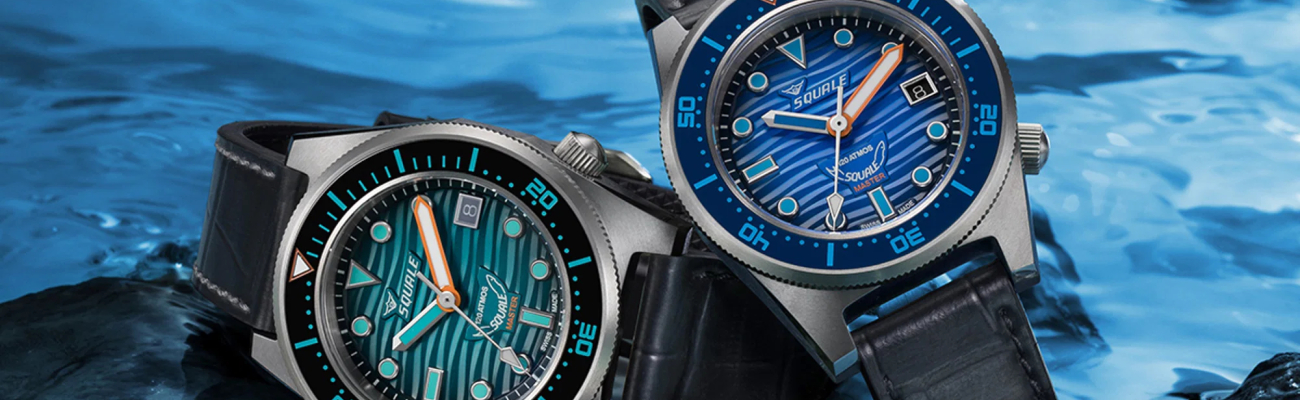
Today, models like the Squale 1521 and the Squale Master are beloved for their iconic, asymmetrical case designs and recessed crowns at the 4 o'clock position.
- The 4 O'Clock Crown: The recessed crown on the 1521 is designed to protect it from impacts and prevent it from digging into the back of the diver's hand. However, this recessed position can make it slightly tricky to thread. When screwing down a Squale crown, always apply gentle inward pressure and turn it counter-clockwise first until you feel a slight "click" (indicating the threads are aligned) before turning it clockwise to tighten. This prevents cross-threading.
- Helium Escape Valves: High-depth models like the Squale 2002 (rated to 1000m) feature a Helium Escape Valve (HEV). This valve allows trapped helium molecules to safely exit the watch during decompression in a saturation diving bell. The HEV is an automatic, one-way valve and requires no manual operation, but it must be kept clean of salt and debris to function properly.
Davosa: Maintaining the Argonautic and Ternos
Davosa is renowned for offering exceptional Swiss-made quality and classic dive watch aesthetics at an accessible price point. Their flagship models, the Ternos Ceramic and the Argonautic, are built like absolute tanks, often powered by the highly reliable Sellita SW200-1 or ETA 2824 automatic movements.
- Ceramic Bezel Care: The Davosa Ternos features a high-tech ceramic bezel insert. Ceramic is incredibly scratch-resistant and impervious to UV fading, ensuring the bezel will look brand new for decades. However, ceramic can shatter if subjected to a sharp, direct impact against a hard surface like a boat deck or a rock. While you don't need to baby it, be mindful of blunt force trauma.
- Manual Helium Valves: Some Davosa Argonautic models feature a manual Helium Escape Valve located at the 10 o'clock position. Unlike automatic valves, this crown must be manually unscrewed during decompression. For 99.9% of wearers who are not living in pressurized saturation habitats, this valve should remain tightly screwed down at all times to ensure maximum water resistance.
- Movement Regulation: The Sellita SW200-1 inside your Davosa is a workhorse. If you notice the watch suddenly running significantly fast (e.g., gaining several minutes a day), it has likely become magnetized—a common issue we will address below.
Everyday Care for the "Desk Diver"
Even if your dive watch never sees anything deeper than a swimming pool, it still faces daily threats in the modern urban environment.
Magnetism: The Invisible Enemy
We live in a world surrounded by magnetic fields: laptops, smartphone speakers, magnetic tablet covers, and induction chargers. If the delicate steel hairspring inside your mechanical watch becomes magnetized, the coils will stick together. This effectively shortens the spring, causing the watch to run erratically fast.
To prevent this, avoid resting your Squale or Davosa directly on top of electronic devices. If your watch does become magnetized, do not panic. It is not permanently damaged. A watchmaker can fix this in less than five minutes using a demagnetizer, which subjects the watch to an alternating magnetic field to neutralize the charge.
Temperature Shocks
While dive watches are built to withstand temperature variations, rapid, extreme thermal shocks should be avoided. For example, do not leave your watch baking in the direct sun on a hot beach towel and then immediately plunge it into freezing ocean water. The rapid contraction of the metal can compromise the gaskets and cause condensation to form on the inside of the crystal.
If you ever see fog or condensation form on the inside of your watch glass, it is a horological emergency. Pull the crown out to stop the movement and take it to a watchmaker immediately. Moisture inside the case will begin rusting the steel components within 24 hours.
Conclusion: Protect Your Investment at WatchExclusive
A mechanical dive watch is one of the few luxury items that is genuinely designed to accompany you through the most extreme adventures of your life. Whether you are drawn to the rich, pioneering history of a Squale or the meticulous, modern engineering of a Davosa, these timepieces are built to last a lifetime—provided you do your part.
By understanding the limits of water resistance, committing to the post-dive freshwater rinse, and adhering to a regular servicing schedule, you ensure that your watch remains a reliable, precision instrument for decades to come.
At WatchExclusive, we are passionate about the heritage and the mechanics of the dive watch. We are proud to offer a curated selection of the finest professional divers from Squale, Davosa, and other premium independent brands. We invite you to explore our collection, find the perfect aquatic companion for your wrist, and dive into the world of mechanical horology with confidence. Treat your watch with respect, and it will never let you down, no matter how deep you go.
Share this content