

Shopping Cart



The History of the Panda Dial: From 1960s Racing to Seiko's 2026 Power Design Project
By :
F. Nagy -
Categories :
Interesting Watch Facts
Table of contents
keyboard_arrow_down
- Key Takeaways
- The Birth of the Panda Dial in 1960s Motorsports
- Why the High-Contrast Design Endures
- Iconic Chronographs That Defined the Era
- The Rolex Daytona and the Paul Newman Legacy
- Heuer Carrera and Breitling Top Time
- The Evolution: Reverse Pandas and Modern Interpretations
- Seiko's Power Design Project: A Playground for Horological Innovation
- The 2026 Seiko Power Design Project Panda Chronograph
- A Literal Take on a Classic Nickname
- Technical Specifications and Playful Details
- Why the 2026 Seiko Panda is a Must-Have for Collectors
- Conclusion: Discover Your Next Chronograph at WatchExclusive
- References
Key Takeaways
- Motorsport Origins: The panda dial emerged in the 1960s as a high-contrast, highly legible chronograph design built for professional racing drivers.
- Enduring Legacy: Pioneered by iconic models like the Rolex Daytona and Heuer Carrera, the black-on-white tri-compax layout remains one of the most sought-after aesthetics in horology.
- Seiko's Literal Interpretation: Born from the 2024 Power Design Project, Seiko's 2026 release flips the script by creating a chronograph that literally resembles a panda's face.
- Playful Horology: The 2026 Seiko Panda Chronograph features ear-shaped pushers, bamboo-leaf hands, and a "Sasameter" scale, blending Japanese creativity with reliable quartz precision.
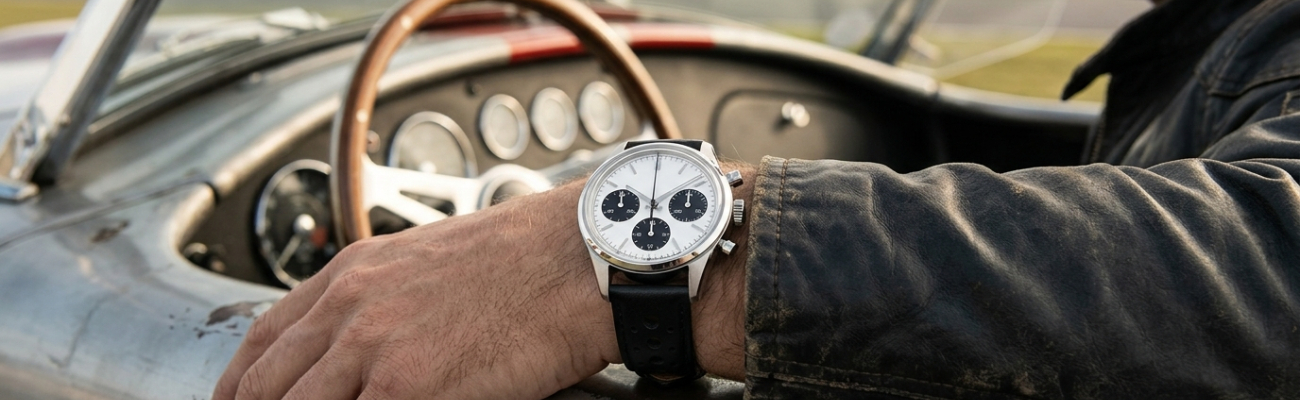
In the lexicon of mechanical watchmaking, few design codes evoke as much passion and historical reverence as the "panda dial." Characterised by a stark white or silver main dial punctuated by black sub-registers, this high-contrast layout was born out of pure necessity. During the golden era of motorsports in the 1960s, professional drivers required timepieces that could deliver split-second legibility amidst the violent vibrations and blinding glare of the racetrack. The solution was a masterclass in functional design, utilising the highest possible contrast ratio to ensure that elapsed time could be read at a mere glance.
Over the decades, the panda dial transcended its utilitarian roots to become a symbol of horological prestige. It graced the wrists of racing legends and Hollywood icons, cementing its status as a holy grail for vintage collectors. The visual symmetry of the tri-compax layout—with sub-dials positioned at 3, 6, and 9 o'clock—naturally forms a face-like geometry. For over half a century, this resemblance was merely a happy accident, a nickname affectionately bestowed by the watch community to describe a serious, purpose-built tool.
However, the narrative of the panda dial took an unprecedented and whimsical turn in October 2026. Challenging the often austere traditions of the industry, the Japanese watchmaking giant unveiled the Seiko Power Design Project Panda Chronograph. Transitioning from a conceptual exhibition piece to a commercial reality, this release took the famous nickname entirely literally. By blending serious manufacturing capabilities with an unapologetic dose of Japanese playfulness, Seiko has redefined what a panda dial can be, bridging the gap between 1960s trackside instruments and modern conceptual art.
The Birth of the Panda Dial in 1960s Motorsports
The 1960s represented a paradigm shift in both automotive engineering and mechanical timekeeping. As race cars grew exponentially faster, competing in grueling endurance events like the 24 Hours of Le Mans or the Mille Miglia, the margin for error shrank to fractions of a second. Drivers relied heavily on their wrist-worn instruments to calculate average speeds and lap times. The traditional monochromatic dials of the 1940s and 1950s, while elegant, often lacked the immediate readability required in a high-octane environment. Watchmakers realised that to serve the professional racer, the chronograph display needed a radical redesign focused entirely on visual clarity.
The breakthrough came through the application of extreme contrast. By placing matte black sub-registers against a stark white or silvered background, manufacturers achieved optimal legibility. This configuration allowed the driver's eye to instantly distinguish the running seconds and elapsed chronograph minutes from the central time-telling hands. The outer edge of the dial was typically reserved for a tachymeter scale, a vital tool that allowed racers to convert elapsed time into speed. By starting the chronograph at a mile or kilometre marker and stopping it at the next, the central seconds hand would point directly to the vehicle's average speed.
This functional layout inadvertently created one of the most recognisable aesthetics in watchmaking. The two horizontal sub-dials at 3 and 9 o'clock acted as "eyes," while the 6 o'clock register served as the "mouth." While the Swiss engineers who drafted these dials were focused solely on telemetry and data visualisation, they had unknowingly birthed the panda dial—a design that would eventually dominate the luxury watch market and dictate collecting trends for generations to come.
Why the High-Contrast Design Endures
The longevity of the panda dial cannot be attributed to functionality alone; it is deeply rooted in human psychology and visual harmony. The human brain is hardwired for pareidolia—the tendency to perceive meaningful images, particularly faces, in random or ambiguous visual patterns. The tri-compax layout of a traditional panda chronograph satisfies this psychological quirk perfectly. The resulting symmetry is inherently pleasing to the eye, offering a balanced aesthetic that feels both dynamic and approachable, softening the hyper-technical nature of a stopwatch.
Beyond psychology, the monochromatic nature of the panda dial offers unparalleled versatility. In the realm of men's style, a black-and-white palette is the ultimate chameleon. A panda chronograph looks just as appropriate paired with a perforated leather rally strap and a driving jacket as it does sliding under the cuff of a tailored suit on a stainless steel bracelet. This adaptability helped the design transition from a specialised tool watch to a staple of everyday luxury, appealing to enthusiasts who wanted a single watch that could do it all.
Furthermore, the modern watch collecting community has elevated the panda dial to near-mythical status. As vintage chronographs from the mid-20th century became highly sought after, the pristine, high-contrast dials stood out in auction catalogues. The rarity of well-preserved examples, combined with the romanticised history of mid-century motorsports, created a perfect storm of demand. Today, the panda configuration is widely considered a hallmark of a brand's chronograph pedigree, a mandatory inclusion in any serious watchmaker's catalogue.
Iconic Chronographs That Defined the Era
The 1960s saw a fierce rivalry among Swiss watchmakers to dominate the racing chronograph market. Interestingly, many of these competing brands relied on the same foundational mechanics, most notably the Valjoux 72 manual-wind calibre. This legendary 13-ligne ébauche, featuring a robust column-wheel mechanism and a lateral clutch, provided the engine for the era's most famous panda dials. Because the internal mechanics were shared, brands had to focus their competitive efforts entirely on dial design, typography, and case architecture.
The Rolex Daytona and the Paul Newman Legacy
Introduced in 1963, the Rolex Cosmograph Daytona reference 6239 was the Crown's definitive answer to the racing chronograph. While early models featured monochromatic dials, Rolex soon introduced "exotic dials" manufactured by Singer. These dials featured a stepped outer track, art-deco typography in the sub-registers, and square hash marks—elements that maximised the panda effect and gave the watch a highly distinctive, avant-garde look.
Despite being a slow seller at the time of its release, this specific configuration was immortalised by actor and racer Paul Newman. His personal Daytona, a gift from his wife Joanne Woodward bearing the inscription "Drive Carefully Me", became the most famous watch in the world. According to Forbes, the 2017 Phillips auction of this exact timepiece shattered records, hammering for an astonishing $17.8 million. This watershed moment cemented the "Paul Newman" Daytona as the undisputed king of panda dials and ignited a global frenzy for high-contrast chronographs.
Heuer Carrera and Breitling Top Time
While Rolex captured the Hollywood spotlight, Heuer was arguably the true king of the paddock. Under the leadership of Jack Heuer, the brand launched the Heuer Carrera in 1963. Obsessed with clean, uncluttered design, Heuer moved the tachymeter scale off the dial and onto the inner tension ring. This innovation allowed the panda dial of the Carrera to breathe, resulting in a masterclass of minimalist legibility that remains a benchmark for modern chronographs.
Simultaneously, Willy Breitling sought to capture a younger, more dynamic demographic with the Breitling Top Time. Moving away from the hyper-technical slide rules of the Navitimer, the Top Time embraced bold, graphic panda and "Zorro" dials. These watches were marketed as entry-level luxury for young professionals, proving that the panda aesthetic could be both a serious racing tool and a vibrant fashion statement.
The Evolution: Reverse Pandas and Modern Interpretations
As the panda dial gained traction, watchmakers naturally began experimenting with its inverse. The "reverse panda"—featuring a matte black main dial with stark white sub-registers—offered a stealthier, more aggressive look. Iconic models like the Heuer Autavia and early variations of the Omega Speedmaster utilised this layout to reduce glare even further. By prioritising the glowing tritium hands against the dark background, these watches became the preferred instruments for night racing and aviation.
The late 1960s brought the race for the first automatic chronograph, culminating in 1969 with the release of the Zenith El Primero, the Chronomatic consortium's Calibre 11, and the Seiko 6139. As the underlying technology evolved, so did the execution of the panda dial. The introduction of automatic winding and higher beat rates (such as the El Primero's 36,000 vibrations per hour) meant that these high-contrast dials were now housing some of the most advanced micro-mechanics in the world, transitioning from disposable tools to cherished luxury items.
Today, the panda motif has permeated the highest echelons of haute horlogerie. Integrated bracelet sports watches, such as the Vacheron Constantin Overseas Chronograph and the Audemars Piguet Royal Oak Chronograph, frequently utilise panda configurations to add a sporty edge to their luxurious finishing. The design has proven entirely future-proof, seamlessly adapting to modern materials like ceramic bezels and sapphire dials while retaining its core visual identity.
Seiko's Power Design Project: A Playground for Horological Innovation
While Swiss brands spent decades refining the traditional panda dial, Seiko has always maintained a uniquely Japanese approach to watchmaking—one that balances relentless technical pursuit with deep cultural storytelling. This philosophy is best exemplified by the Seiko Power Design Project. Originally launched in 2001, this internal initiative was created to free Seiko's in-house designers from the commercial constraints of their day-to-day work, encouraging them to explore the pure essence of timekeeping without worrying about immediate sales figures.
After a brief hiatus, the project was revived in 2022, leading to the highly acclaimed 2024 "Incredibly Specialized Watches" exhibition. The brief was simple yet challenging: design timepieces for highly specific, almost absurdly niche audiences. The resulting concepts were a testament to unbridled creativity. They included the "Sukiyaki" watch, which featured precise timing instructions for cooking the traditional Japanese hot pot, and the "Hide-and-Seek" watch, equipped with a specialised 1-minute count and 10-minute catch timer.
Among these avant-garde creations was a concept by in-house designer Kiyotaka Sakai. Sakai looked at the watch industry's obsession with the "panda dial" and asked a simple, provocative question: Do panda-style dials really resemble pandas?
Stripping away the serious motorsport heritage, Sakai designed a chronograph that literally embraced the animal's identity. It was a brilliant exercise in lateral thinking, but few expected this whimsical concept to ever see the inside of a manufacturing facility.
The 2026 Seiko Power Design Project Panda Chronograph
In October 2026, Seiko shocked the horological community by announcing that Sakai's concept was transitioning from a museum curiosity to a commercial reality. Released as part of the Power Design Project Collection 2, the new Seiko Panda Chronograph represents a delightful departure from the brand's usual lineup of rugged dive watches and elegant dress pieces. It is a watch that refuses to take itself too seriously, yet is executed with Seiko's trademark attention to detail.
A Literal Take on a Classic Nickname
The dial of the 2026 Seiko Panda is a masterclass in playful design. The white base features a stamped radial guilloché pattern that mimics the texture of a panda's fur. The traditional black sub-dials have been reshaped into droopy, asymmetrical eye patches, perfectly capturing the wistful expression of the giant bear. Below the central pinion, a small printed nose and mouth complete the face, replacing the standard text found on traditional chronographs.
Seiko's designers left no stone unturned when integrating the theme. The hour and minute hands are uniquely shaped like bamboo leaves, a nod to the animal's primary diet. Even the traditional tachymeter scale—the very tool that birthed the original 1960s panda dials—has been playfully rebranded. It is now the Sasameter (derived from "sasa," the Japanese word for bamboo grass). The scale humorously indicates that if a panda were to run at full speed for two minutes, it would reach its theoretical top speed of 30 km/h.
Technical Specifications and Playful Details
To accommodate the highly specific design, Seiko opted for a robust quartz movement, the calibre 8T61. This choice was not merely for affordability; it was a structural necessity. The movement allows for a "bullhead" configuration, moving the chronograph pushers to the 11 and 1 o'clock positions. Coated in black, these recessed pushers serve as the panda's ears, completing the silhouette of the watch head. The stainless steel case measures a substantial 43mm in diameter with a thickness of 14.6mm—fitting dimensions for a watch inspired by a giant bear.
The thematic dedication continues onto the caseback, which features a striped pattern resembling the panda's shoulders. In a stroke of anatomical accuracy, a three-dimensional white tail is positioned at the bottom of the caseback, staying true to the fact that real pandas have white, not black, tails. The words "LIMITED EDITION" are proudly engraved above it.
The collection launched with two distinct limited editions. The Seiko HHK001 features the classic black-and-white adult panda colourway and is limited to 3,000 pieces. Its sibling, the Seiko HHK002, is limited to 2,000 pieces and features a pink-and-white palette. According to Seiko's design team, this pink variant is inspired by the delicate, hairless appearance of a newborn baby panda, leaning heavily into the Japanese cultural phenomenon of "kawaii" (cuteness).
Why the 2026 Seiko Panda is a Must-Have for Collectors
In an industry that often suffers from an excess of self-importance, the 2026 Seiko Panda Chronograph is a breath of fresh air. It challenges the notion that a serious watch collection must only consist of austere, historically rigid timepieces. By blending legitimate watchmaking infrastructure with an unapologetically fun concept, Seiko has created a watch that appeals to both hardcore horology enthusiasts and casual fans of Japanese pop culture.
From a collecting standpoint, the watch offers immense value. Priced accessibly at around €590, it provides an entry point into limited-edition, concept-driven horology without the exorbitant price tag usually associated with avant-garde designs. The use of a reliable quartz movement ensures that it is a grab-and-go piece, perfect for weekend wear or as a conversation starter at watch meetups. It proves that a watch does not need an intricate in-house mechanical calibre to be culturally significant or highly desirable.
Furthermore, the release of the HHK001 and HHK002 signals a bold new era for Seiko. It demonstrates the brand's willingness to listen to the community and take calculated risks. By bringing the Power Design Project to the global retail market, Seiko is blurring the lines between industrial design exhibitions and consumer products, ensuring that their most creative ideas don't just live in archives, but on the wrists of enthusiasts worldwide.
Conclusion: Discover Your Next Chronograph at WatchExclusive
The evolution of the panda dial is a fascinating journey through the history of modern watchmaking. What began in the 1960s as a strict, utilitarian requirement for motorsport professionals has blossomed into one of the most beloved and versatile design languages in the world. Whether it is the high-octane legacy of a vintage racing chronograph or the joyful, literal interpretation of the 2026 Seiko Power Design Project Panda Chronograph, the black-and-white layout continues to captivate the hearts of collectors.
At WatchExclusive, we understand the profound connection between a watch enthusiast and the perfect dial. Whether you are drawn to the historical significance of a traditional mechanical chronograph, the rugged reliability of a modern sports watch, or the playful innovation of limited-edition Japanese releases, our curated collection has something to elevate your wrist. We pride ourselves on offering timepieces that tell a story, from the racetrack to the design studio.
We invite you to explore our extensive range of premium timepieces. Discover the precision, heritage, and style that define the world's greatest watchmakers by visiting WatchExclusive today, and find the chronograph that perfectly matches your passion for horology.
References
- Bauer, Hyla.
Everything You Need To Know About Panda Dial Watches.
Chrono24 Magazine, 2 Nov. 2022. - Su, JX.
Seiko's Power Design Project “Panda” Comes to Life.
SJX Watches, 7 Oct. 2026. - Deployant Editorial Team.
Seiko Power Design Project: Panda Chronograph.
Deployant, 6 Oct. 2026. - Oracle Time Editorial.
Seiko Introduce Power Design Project Panda Chronograph Limited Edition.
Oracle Time, 6 Oct. 2026. - Seiko Watch Corporation.
Power Design Project Collection 2.
Seiko Official Archives, Oct. 2026.
Share this content

