Shopping Cart





The Return of the Bullhead Chronograph: Analysing the 1970s Motorsport Watch Revival
By :
F. Nagy -
Categories :
Industry News & Market Trends
Table of contents
keyboard_arrow_down
- Key Takeaways
- The Functional Origins of the Bullhead Design
- The Golden Era of Motorsport Chronographs
- Citizen’s Horological Milestone: The 1973 Tsuno Chrono
- The Advanced Calibre 8110A
- Pop Culture and the Vintage Watch Revival
- Modern Execution: The Citizen Retro Bullhead AN3660-73X
- Quartz Reliability Meets 1970s Aesthetics
- Why the Bullhead Silhouette Endures Today
- Conclusion: Embrace the Racing Heritage at WatchExclusive
- References
Key Takeaways
- Motorsport Origins: The bullhead chronograph was engineered in the late 1960s for racing drivers, moving the crown and pushers to the top of the case for unobstructed access while gripping a steering wheel.
- Horological Innovation: The original 1973 Citizen Tsuno Chrono featured the highly advanced Calibre 8110A, boasting a column-wheel, vertical clutch, and flyback functionality.
- Pop Culture Resurgence: The bullhead design gained renewed mainstream attention after being prominently featured on the wrist of Brad Pitt's character in the cinematic hit Once Upon a Time in Hollywood.
- Modern Accessibility: The Citizen Retro Bullhead Chronograph AN3660-73X faithfully revives the 1970s aesthetic, combining the iconic asymmetrical case with a highly reliable Japanese quartz movement.
The landscape of modern horology is currently defined by a profound appreciation for the past, with brands continuously mining their archives to resurrect mid-century designs. Among the most distinctive and functionally driven silhouettes to emerge from this vintage revival is the bullhead chronograph. Characterised by its unconventional pusher placement and asymmetrical case, this design language speaks directly to the golden age of motorsport, a time when mechanical watches were essential timing instruments rather than mere luxury accessories.
Unlike traditional chronographs that place their operational controls on the right flank of the case, the bullhead shifts the crown and pushers to the 12 o'clock position. This radical reconfiguration was not born out of a desire to be avant-garde; it was a strict adherence to the principle of form following function. In an era before digital telemetry, drivers relied on mechanical precision to calculate lap times and average speeds. The standard wristwatch layout proved cumbersome in the cockpit, prompting watchmakers to rethink the fundamental architecture of the chronograph.
Today, as collectors increasingly seek out timepieces with authentic historical narratives and unique wrist presence, the bullhead has transitioned from a quirky historical footnote to a highly sought-after commodity. The resurgence of this 1970s aesthetic highlights a broader industry trend: a shift away from ubiquitous, safe designs towards bold, purpose-built tool watches that tell a compelling story. By examining the origins, the mechanical milestones, and the modern iterations of the bullhead, we can fully appreciate why this unconventional silhouette is capturing the imagination of a new generation of watch enthusiasts.
The Functional Origins of the Bullhead Design
To understand the enduring appeal of the bullhead, one must first examine the ergonomic challenges faced by professional racing drivers in the mid-20th century. When gripping a steering wheel, a traditional chronograph with pushers at 2 and 4 o'clock can be difficult to operate, especially when wearing thick, fire-resistant Nomex racing gloves. Furthermore, the protruding crown at 3 o'clock often digs into the back of the driver's hand during sharp, high-G turns, causing discomfort and distraction.
The horological solution was brilliantly simple yet visually radical: rotate the movement 90 degrees anticlockwise inside the case. By positioning the crown at 12 o'clock and the pushers at 11 and 1 o'clock, watchmakers effectively transformed the wristwatch into a wrist-mounted stopwatch. As noted by vintage watch specialists at Experts Watches, The asymmetrical case design—wider and thicker at the top—naturally tilts the dial towards 6 o'clock when worn, making the time easier to read at a glance.
This top-heavy, wedge-shaped profile allowed drivers to actuate the chronograph with their thumb or index finger without removing their hands from the wheel, ensuring precise timing of laps and intervals. Some drivers even preferred to wear these watches on the inside of their wrists, further optimising the viewing angle while their hands were positioned at ten and two o'clock on the steering wheel. The bullhead was, in every sense, a dedicated piece of racing equipment.
The Golden Era of Motorsport Chronographs
The late 1960s and early 1970s represented a period of immense mechanical confidence and experimentation in the Swiss and Japanese watch industries. The year 1969 was particularly pivotal, marking the introduction of the first automatic chronograph movements—a fierce competition between the Chronomatic group, Zenith, and Seiko. It was during this era of rapid innovation that the bullhead design truly flourished, with several prominent brands releasing their own interpretations of the ultimate driver's watch.
Omega introduced the Omega Seamaster Bullhead (reference 146.011) in 1969, a visually striking piece with an internal rotating bezel and a massive shield-shaped case. Around the same time, Breitling released the Breitling Pupitre (reference 7101), and Seiko unveiled the Seiko 6138-0040, a robust automatic chronograph that became a staple among racing enthusiasts. These watches were unapologetically bold, often featuring vibrant dial colours, contrasting sub-dials, and thick, cushion-shaped cases that perfectly encapsulated the flamboyant design ethos of the 1970s.
However, because they were so unconventional and purpose-built, their initial production runs were relatively short-lived. The quartz crisis was looming, and consumer tastes soon shifted towards slimmer, battery-powered timepieces. Consequently, the mechanical bullheads of the 1970s disappeared almost as quickly as they arrived. That short, explosive lifespan is exactly why well-preserved vintage examples are so highly prized in today's collector market, representing a fleeting moment of unbridled mechanical creativity.
Citizen’s Horological Milestone: The 1973 Tsuno Chrono
While Swiss and other Japanese brands were early adopters of the bullhead layout, Citizen's entry into the arena in 1973 left an indelible mark on horological history. The brand introduced the Citizen Challenge Timer, affectionately dubbed the Tsuno Chrono (Japanese for "horned chronograph") by domestic collectors. This timepiece was not merely a stylistic exercise to capitalise on a trend; it was a profound showcase of Citizen's formidable engineering capabilities.
The original Tsuno Chrono featured a compact 38mm case, which was surprisingly wearable compared to the bulky, oversized dimensions of its Swiss and domestic competitors. It utilised a base metal case with a stainless steel bezel, and its dial layouts—often featuring high-contrast "panda" or "reverse panda" configurations with vibrant orange chronograph hands—became instantly recognisable. The true marvel of the Citizen Challenge Timer, however, lay beneath the dial, hidden from plain sight but deeply respected by watchmakers.
The Advanced Calibre 8110A
Powering the 1973 bullhead was the Calibre 8110A, an automatic chronograph movement that was remarkably advanced for its time, and arguably superior to many Swiss counterparts of the era. According to horological archives detailed by Dialicious, this mechanism combined automatic winding, manual winding, a column-wheel and vertical-clutch chronograph, flyback, day-date display and an operating frequency of 28,800 vibrations per hour.
The inclusion of a column-wheel ensured smooth, precise pusher action, eliminating the stiffness often associated with cheaper cam-actuated chronographs. The vertical clutch allowed the chronograph to run continuously without causing excessive wear to the gear train or causing the seconds hand to stutter upon activation. Furthermore, the flyback function (retour-en-vol)—enabling the user to reset and restart the chronograph with a single push—was a highly complex feature typically reserved for elite aviation timepieces. Packing all of this high-end technology into a compact, mass-produced movement was a testament to Citizen's prowess during the mechanical watchmaking peak.
Pop Culture and the Vintage Watch Revival
The resurgence of the bullhead design in the modern era can be attributed to a combination of cyclical fashion trends and significant pop culture exposure. Vintage watches have increasingly become symbols of discerning taste, with collectors gravitating towards models that offer a distinct narrative and a break from the monotony of standard dive watches. The bullhead, with its undeniable 1970s swagger and motorsport pedigree, perfectly fits this criterion.
This niche design was thrust into the mainstream spotlight by Quentin Tarantino's 2019 cinematic masterpiece, Once Upon a Time in Hollywood. Brad Pitt's character, the rugged and effortlessly cool stuntman Cliff Booth, prominently wears a gold-tone vintage Citizen Challenge Timer mounted on a wide leather bund strap. The watch perfectly complements his vintage aviators, Hawaiian shirts, and washed-out denim, cementing the timepiece as an icon of retro masculinity.
As highlighted by The Revolver Club, while the film is set in 1969 and the Calibre 8110A wasn't introduced until 1972, this deliberate anachronism served as a brilliant easter egg that sent watch enthusiasts scrambling to acquire the original models. The 'Brad Pitt effect' caused vintage prices for the Tsuno Chrono to skyrocket overnight. More importantly, it proved to the watch industry that there was a massive, untapped appetite for the asymmetrical bullhead aesthetic among modern consumers.
Modern Execution: The Citizen Retro Bullhead AN3660-73X
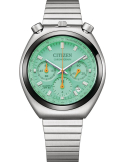
Recognising the surging demand for its historical designs and the renewed interest sparked by Hollywood, Citizen wisely looked to its archives to revive the Tsuno Chrono for a new generation. The result is the Citizen Retro Bullhead Chronograph AN3660-73X Watch, a timepiece that masterfully balances vintage charm with modern manufacturing tolerances and everyday practicality.
This modern iteration retains the iconic 38mm case diameter of the 1973 original, ensuring it remains faithful to the compact, wearable proportions that made the vintage models so appealing. In an era where modern chronographs often exceed 42mm, the restrained sizing of the Citizen Retro Bullhead Chronograph AN3660-73X is a breath of fresh air, allowing the watch to sit comfortably on a wide variety of wrist sizes without feeling obtrusive.
Aesthetically, the watch is a triumph. It features a striking emerald green dial with a subtle sunburst finish, providing a high-contrast backdrop for the silver sub-dials and the vibrant orange chronograph hands. The faceted applied indices and the sloping tachymeter scale add depth and texture to the dial. The transition to a full stainless steel case and integrated bracelet offers a robust, contemporary feel, while the 50-metre water resistance ensures it can handle the rigours of daily wear far better than its delicate vintage ancestors.
Quartz Reliability Meets 1970s Aesthetics
While the original 1970s models were powered by complex mechanical movements, the Citizen Retro Bullhead Chronograph AN3660-73X utilises the highly reliable Calibre 0510 Japanese quartz movement. This strategic engineering choice makes the watch significantly more accessible and easier to maintain, without sacrificing the visual impact and functional layout of the bullhead design.
The quartz movement provides exceptional accuracy and features a one-second chronograph capable of measuring up to twelve hours, alongside a practical date complication. For the modern enthusiast who desires the aggressive, motorsport-inspired look of a 1970s chronograph but prefers the 'grab-and-go' convenience of quartz, this modern reissue represents the perfect compromise. It captures the rebellious spirit of the era without the exorbitant servicing costs and fragility often associated with maintaining 50-year-old mechanical chronographs.
Why the Bullhead Silhouette Endures Today
The enduring appeal of the bullhead chronograph lies in its steadfast refusal to conform. In an industry often dominated by safe, iterative designs and endless variations of the standard dive watch, the bullhead stands out as a bold statement of intent. It is a natural conversation starter, a piece of wrist architecture that immediately signals the wearer's appreciation for horological history, unconventional engineering, and the golden age of racing.
Furthermore, the bullhead represents a tangible connection to the visceral, analogue era of motorsport. Before the advent of digital telemetry, GPS timing, and paddle-shift gearboxes, drivers relied on mechanical instruments and raw intuition to measure their performance. Wearing a bullhead chronograph is a way to tap into that romanticised era of racing, where man and machine were pushed to their absolute limits on tracks like Le Mans and the Nürburgring.
The design's inherent functionality—the ease of reading the tilted dial, the tactile satisfaction of actuating the top-mounted pushers—remains just as relevant today. Even if the modern wearer is more likely to use the chronograph for timing a parking meter or a shot of espresso rather than a qualifying lap, the ergonomic benefits of the bullhead layout are undeniable. It is a testament to the idea that truly great, purpose-driven design never really goes out of style; it simply waits for the right moment to be rediscovered.
Conclusion: Embrace the Racing Heritage at WatchExclusive
The revival of the 1970s motorsport watch is more than just a passing trend; it is a celebration of an era when watchmakers dared to rethink the fundamental architecture of the wristwatch to solve real-world problems. The bullhead chronograph, with its ergonomic focus, top-mounted pushers, and unmistakable silhouette, remains one of the most fascinating and charismatic by-products of that golden age of horological experimentation.
Whether you are a seasoned collector drawn to the historical significance of the design, or a style-conscious enthusiast looking for a timepiece that breaks the mould of traditional watchmaking, the modern iterations of these classic racing watches offer unparalleled character. We invite you to explore this unique chapter of horological history and experience the perfect blend of retro aesthetics and modern Japanese reliability by discovering the Citizen Retro Bullhead Chronograph AN3660-73X Watch at WatchExclusive. Elevate your collection with a timepiece that truly takes the bull by the horns and honours the legacy of motorsport timing.
References
- Experts Watches. Vintage BullHead Chronograph Watches: History, Design & Collector's Guide.
- Dialicious. Citizen Chronograph Bullhead: 6 owner reviews with 84 photos on the wrist.
- The Revolver Club. The Story of The Citizen Bullhead Chronograph (AKA The Brad Pitt Watch).
- Wound For Life. Lessons in Wristory: Omega Seamaster Bullhead.
Share this content