Shopping Cart






The First Watch in Space: The True Story of Yuri Gagarin's Sturmanskie
By :
F. Nagy -
Categories :
Interesting Watch Facts
Table of contents
keyboard_arrow_down
- Key Takeaways
- The Dawn of the Space Age and the Vostok 1 Mission
- The First Moscow Watch Factory and the Birth of Sturmanskie
- Horological Anatomy of Gagarin’s Space Watch
- The Great Debate: 15 Jewels or 17 Jewels?
- The Legacy of the First Space Watch
- Modern Reissues: The Sturmanskie Gagarin 24 Hours
- Expanding the Cosmos: The Sturmanskie Open Space Collection
- Conclusion: Own a Piece of Space History at WatchExclusive
- References
Key Takeaways
- The First Space Watch: On April 12, 1961, Yuri Gagarin wore a 33mm Sturmanskie during the Vostok 1 mission, making it the first watch to survive outer space.
- Military Origins: Produced by the First Moscow Watch Factory, the Sturmanskie was never sold to the public; it was standard-issue equipment exclusively for Soviet Air Force pilots.
- Horological Significance: The watch featured a robust 17-jewel manual wind movement with a hacking seconds mechanism, essential for precise mission synchronisation.
- Modern Reissues: Today, the brand honours this legacy with timepieces like the STURMANSKIE Gagarin 24 hours 2426/4571144 Watch, designed for modern enthusiasts while preserving Soviet aerospace heritage.
When discussing the history of space exploration and horology, the conversation inevitably gravitates towards the moon and the legendary chronographs that accompanied the Apollo missions. However, the true genesis of extraterrestrial timekeeping occurred years earlier, behind the Iron Curtain. On April 12, 1961, humanity severed its terrestrial bonds for the first time. Aboard the Vostok 1 spacecraft, a young Soviet pilot named Yuri Gagarin was launched into the cosmos, orbiting the Earth in a flight that lasted exactly 108 minutes. Strapped to his wrist, over his bright orange SK-1 spacesuit, was a modest, purpose-built mechanical timepiece: the Sturmanskie Type 2.
This event marked a monumental milestone not only for aerospace engineering but also for mechanical watchmaking. Prior to Gagarin's flight, scientists and horologists could only theorise about how a mechanical escapement would behave in the harsh environment of zero gravity and extreme G-forces. The watch's flawless performance in orbit proved that traditional watchmaking could withstand the rigours of spaceflight. Today, the story of Gagarin's watch remains one of the most fascinating, yet frequently overshadowed, chapters in horological history. It is a tale of military secrecy, robust engineering, and a legacy that continues to inspire modern watchmakers and collectors alike.
The Dawn of the Space Age and the Vostok 1 Mission
The late 1950s and early 1960s were defined by the intense geopolitical and technological rivalry of the Space Race. The Soviet Union had already stunned the world with the launch of Sputnik 1 in 1957, but the ultimate goal was to put a human being into orbit. The Vostok programme was initiated to achieve this unprecedented feat. The spacecraft itself, the Vostok 3KA, was a marvel of early aerospace engineering, consisting of a spherical descent module and a conical instrument module. However, the physiological and mechanical unknowns of spaceflight were vast. No one knew for certain how the human body—or delicate mechanical instruments—would react to sustained weightlessness.
Yuri Gagarin, a 27-year-old senior lieutenant in the Soviet Air Forces, was selected from the "Vanguard Six" elite cosmonaut training group due to his exceptional piloting skills, physical endurance, and calm psychological demeanour. When he boarded the Vostok 1 capsule at the Baikonur Cosmodrome, he carried with him standard-issue military equipment, which included his personal flight watch. Unlike later space missions where watches were rigorously tested and officially certified by space agencies, Gagarin's timepiece was simply the watch he had been issued upon graduating from the Orenburg Military Aviation Pilot School.
The flight of Vostok 1 subjected both the cosmonaut and his equipment to extreme conditions. During launch and reentry, the gravitational forces peaked at nearly 8Gs. In orbit, the environment shifted to complete microgravity. For a mechanical watch, which relies on the precise oscillation of a balance wheel and the tension of a mainspring, these conditions could theoretically cause severe timing deviations or complete mechanical failure. Yet, throughout the 108-minute journey, Gagarin's watch ticked flawlessly, providing a reliable backup timing instrument in an era before digital telemetry was entirely foolproof.
The First Moscow Watch Factory and the Birth of Sturmanskie
To understand the pedigree of the first watch in space, one must look back to the industrialisation of the Soviet Union. In 1930, under the directive of Joseph Stalin, the Soviet government established the First State Watch Factory (later renamed the First Moscow Watch Factory or 1MWF). The goal was to eliminate the state's reliance on imported Western timepieces for its military and railway infrastructure. To jumpstart production, the Soviets purchased the defunct American watchmaking companies Dueber-Hampden and Ansonia, moving their machinery and several key personnel to Moscow.
By the late 1940s, the Soviet watch industry had matured significantly. In 1949, the 1MWF introduced a new line of watches specifically designed for the Soviet Air Forces. The brand was named Sturmanskie (Штурманские), which translates directly to "Navigator's." These watches were strictly military-issue; they were not available to the civilian public and were awarded exclusively to pilots and navigators upon their graduation from military flight schools. This exclusivity imbued the brand with a profound sense of prestige and operational authenticity.
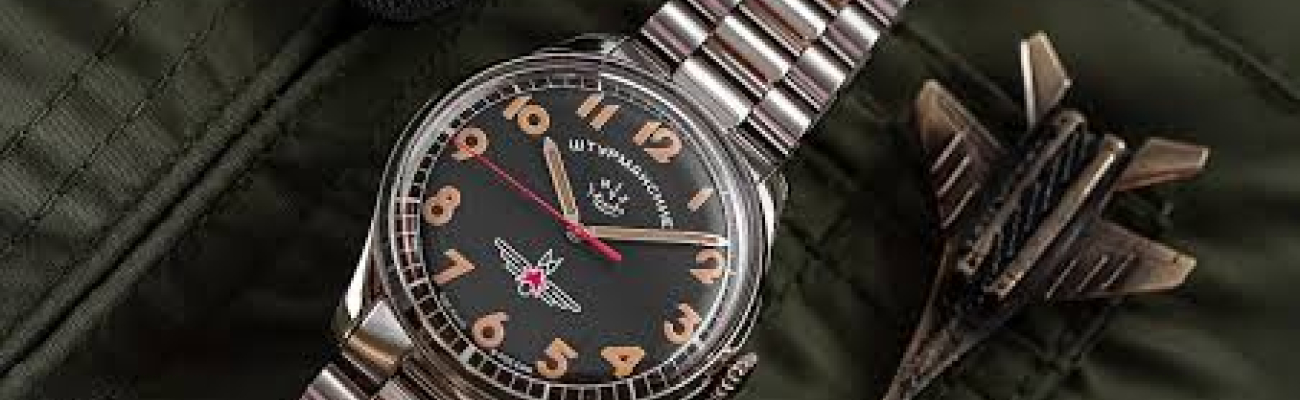
The design of the early models was dictated entirely by the functional requirements of military aviation. The dials were highly legible, featuring bold Arabic numerals coated in radioactive radium for nighttime visibility. The most distinctive visual element was the emblem located below the 12 o'clock position: a stylised winged bomb superimposed over a red Soviet star. This insignia served as a constant reminder of the watch's martial purpose. It was a tool watch in the purest sense, devoid of unnecessary ornamentation and built to survive the harsh vibrations and temperature fluctuations of early jet fighter cockpits.
Horological Anatomy of Gagarin’s Space Watch
The specific watch worn by Gagarin on April 12, 1961, was a marvel of mid-century utilitarian engineering. By modern standards, the watch was remarkably diminutive, featuring a 33mm stainless steel case with a thickness of approximately 12mm and a lug width of 16mm. However, in the 1950s, this was a standard size for men's military watches. The case utilised a robust, pillow-shaped crown and a screw-down case back, providing a basic but effective level of water and dust resistance.
The true horological significance of the watch lay beneath its dial. The movement was heavily influenced by the French Lip R26 caliber, a design the Soviets had legally acquired the rights to manufacture in the late 1930s. This architecture evolved into the famous Soviet Pobeda movement (K-26), which was subsequently modified for military aviation use. The most critical modification was the addition of a hacking seconds mechanism. When the crown was pulled out, a small lever would arrest the balance wheel, stopping the sweeping seconds hand. This allowed flight crews to synchronise their watches to the exact second before a mission—a vital function for coordinated military operations and celestial navigation.
Aesthetically, the dial was a masterclass in functional typography and colour contrast. The hour and minute hands were crafted from blued steel and shaped like lances, filled with luminous material. The central seconds hand was painted a vibrant red, ending in a distinctive cloverleaf counterbalance. According to Sean Lorentzen in Worn & Wound, the design can be described as halfway between a field watch and an A-type flieger
, noting that its remarkably restrained graphic dial visually balanced the military origins of the timepiece.
The Great Debate: 15 Jewels or 17 Jewels?
Within the passionate community of vintage watch collectors, a long-standing debate exists regarding the exact specifications of the watch Gagarin wore. The 1MWF produced two distinct generations of the watch prior to 1961, commonly referred to by collectors as the Type 1 and the Type 2.
The Type 1, introduced in 1949, featured a 15-jewel movement, a distinctive cone-shaped crown, and a snap-on case back. The hands were straight with small pointer tips. The Type 2, introduced later in the 1950s, represented a significant technical upgrade. It housed a 17-jewel manual wind movement, which provided better shock protection and longevity. The Type 2 also featured a standard cylindrical crown, a more secure screw-down case back, and the lance-shaped hands that are most commonly associated with Gagarin's flight.
While the Soviet space program was notoriously secretive, making absolute verification difficult, the overwhelming consensus among horological historians is that Gagarin wore the Sturmanskie Type 2. The 17-jewel movement was the standard issue for pilots graduating in the late 1950s, aligning perfectly with Gagarin's graduation from the Orenburg flight school in 1957. Furthermore, historical photographs of Gagarin post-flight, as well as the watch displayed in the factory museum, exhibit the distinct visual characteristics of the Type 2 model. As noted by Fratello Watches in their exploration of Russian watch dating profiles, the 33mm case and specific dial layout of the Type 2 remain the definitive blueprint for the first watch in space.
The Legacy of the First Space Watch
The successful return of Vostok 1 transformed Yuri Gagarin into an international icon and cemented his watch's place in history. Following the flight, the First Moscow Watch Factory capitalised on this monumental achievement. In 1964, the factory officially changed its name to Poljot (Полёт), meaning "Flight," in direct honour of Gagarin's mission. The brand continued to produce highly specialised timepieces for the Soviet space program, including the famous Strela chronograph worn by Alexei Leonov during the first spacewalk in 1965.
Despite the factory's name change, the original brand name remained a symbol of ultimate aerospace endurance. For decades, these watches were the official timekeepers of Soviet and Russian cosmonauts, accompanying crews on missions to the Salyut and Mir space stations. They proved their mettle not just in the controlled environment of a capsule, but in the gruelling, long-duration realities of orbital habitation, withstanding magnetic fields, extreme temperature shifts, and the constant micro-vibrations of space station life.
Today, the legacy of the first watch in space is preserved by the modern iteration of the brand. Operating out of Moscow, the company continues to produce timepieces that honour the original mid-century blueprints while incorporating modern materials and manufacturing techniques. For collectors, acquiring one of these timepieces is not just about owning a mechanical watch; it is about wearing a tangible piece of human history.
Modern Reissues: The Sturmanskie Gagarin 24 Hours
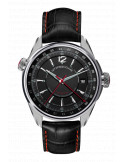
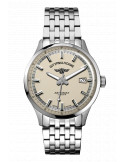
For contemporary watch enthusiasts who wish to connect with this incredible aerospace heritage, the brand offers meticulously crafted modern collections. One of the most compelling modern interpretations is the STURMANSKIE Gagarin 24 hours 2426/4571144 Watch. This timepiece brilliantly bridges the gap between the vintage aesthetics of 1961 and the practical demands of modern horology.
While the original 33mm size is historically accurate, it is often considered too small for modern wrists. The Gagarin 24 Hours model addresses this by scaling the case up to a more contemporary and robust size, ensuring it has a commanding presence on the wrist without losing its vintage charm. The dial retains the highly legible, utilitarian layout of the original military instruments, complete with the iconic winged bomb logo and the distinctive typography that defined Soviet aviation watches.
What truly sets this model apart is its 24-hour complication. In the realm of space exploration, a standard 12-hour dial can become a liability. In the vacuum of space, where astronauts experience multiple sunrises and sunsets within a single 24-hour period (or none at all, depending on the orbit), the human circadian rhythm is easily disrupted. A 24-hour dial allows the wearer to instantly distinguish between day and night back at mission control. Powered by a reliable automatic movement, this watch is a perfect homage to the functional requirements of orbital flight, blending historical reverence with practical, everyday utility.
Expanding the Cosmos: The Sturmanskie Open Space Collection
Beyond the direct reissues of Gagarin's timepiece, the brand's catalogue expands to honour the broader achievements of the Soviet space program. The Open Space collection is a prime example of this dedication, drawing inspiration from the golden age of space exploration while delivering robust, modern specifications.
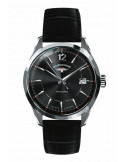
The STURMANSKIE Open Space 2431/1767936 Watch is a standout piece in this lineup. It features a sophisticated 24-hour dial layout, driven by the rugged Vostok 2431 automatic calibre. This movement is renowned for its durability and ease of maintenance, echoing the utilitarian philosophy of the original First Moscow Watch Factory. The dial design is intricate yet highly legible, featuring an inner 24-hour track and an outer minute track, making it an exceptional tool for tracking time across different zones—or different orbits.
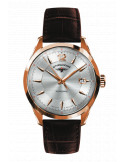
Similarly, the STURMANSKIE Open Space 2431/1767935 Watch offers a striking visual variation within the same robust architectural framework. The use of high-grade stainless steel, domed mineral crystals, and premium leather straps ensures that these watches are not merely museum replicas, but highly capable daily wearers. They capture the adventurous spirit of the 1960s space race, offering collectors a unique alternative to the ubiquitous Swiss space chronographs. By wearing an Open Space model, you are strapping a piece of horological defiance to your wrist—a reminder of the engineers and pilots who pushed the boundaries of what was mechanically and humanly possible.
Conclusion: Own a Piece of Space History at WatchExclusive
The story of Yuri Gagarin and his trusty 33mm navigator's watch is a testament to the ingenuity and resilience of mid-century mechanical watchmaking. It proved that a well-engineered escapement could conquer the ultimate frontier, paving the way for all extraterrestrial timekeeping that followed. While the original timepieces from 1961 are incredibly rare museum artefacts, the spirit of that historic April morning lives on in the brand's modern collections.
Whether you are captivated by the historical accuracy of the vintage reissues or the robust, space-ready functionality of the 24-hour models, these watches offer a unique and compelling narrative for any collector. We invite you to explore our curated Sturmanskie collection at WatchExclusive. Discover the perfect blend of aerospace heritage and mechanical reliability, and secure your own piece of space history today with the STURMANSKIE Gagarin 24 hours 2426/4571144 Watch or the adventurous Open Space series.
References
- Lorentzen, S. (2015). Watches in Space: Yuri Gagarin. Worn & Wound. Available at: https://wornandwound.com/watches-in-space-yuri-gagarin/
- Fratello Watches. (2022). Watch Dating Profiles: Russia — A Starry-Eyed Sturmanskie, A Plucky Poljot, And A Racy Raketa. Available at: https://www.fratellowatches.com/watch-dating-profiles-russia-sturmanskie-poljot-raketa/
- Sturmanskie Official Website. History of the First Watch in Space. Available at: https://sturmanskie.com/
Share this content