

Shopping Cart

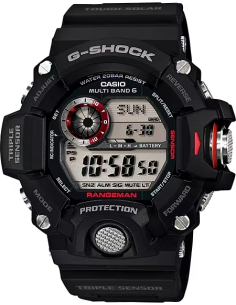




G-SHOCK Survival Features Explained: How the Rangeman GW-9400 ABC Sensors Work
Master the G-SHOCK Rangeman GW-9400 with our in-depth guide to its ABC sensors. Learn how to utilize the altimeter, barometer, and compass for real-world survival and precision outdoor navigation.

Key Takeaways
- Triple Sensor Version 3: The GW-9400 utilizes Casio's advanced sensor suite, offering 95% smaller packaging and 90% less power consumption than previous iterations, allowing for rapid, continuous data reading.
- Barometric Weather Alerts: The built-in barometer tracks atmospheric pressure trends, providing audible alarms and visual indicators for sudden pressure drops that often precede severe storms.
- Altimeter Calibration: Because the altimeter relies on barometric pressure, frequent calibration at known elevations is crucial for accurate ascent and descent tracking in mountainous terrain.
- Magnetic Declination Correction: The digital compass allows for manual declination adjustment, ensuring true north alignment with topographic maps for precise overland navigation.
- Self-Sustaining Power: Tough Solar technology and Multi-Band 6 atomic timekeeping guarantee uninterrupted operation and absolute precision, making the watch a reliable standalone survival instrument.
When venturing into unforgiving environments, the equipment on your wrist must transcend basic timekeeping. It must function as a reliable, standalone instrument capable of providing critical environmental data. Since its introduction, the Casio G-SHOCK Rangeman GW-9400-1ER Watch has established itself as the definitive tool watch for hikers, mountaineers, and military personnel. Its reputation is not built merely on rugged aesthetics, but on the highly capable Altimeter, Barometer, and Compass (ABC) sensor suite housed within its shock-resistant resin case.
Understanding how to extract, interpret, and apply the data from these sensors is what separates a casual wearer from a proficient navigator. The wilderness does not forgive miscalculations, and relying solely on GPS devices—which are susceptible to battery depletion and signal loss under heavy canopy or in deep canyons—can be a fatal error. The mechanical and digital autonomy of a solar-powered ABC watch provides a critical fail-safe. By mastering the barometric trends, altimeter calibrations, and compass bearings, outdoorsmen can predict weather shifts, track vertical progress, and navigate complex topography without relying on external power grids or satellite networks.
This technical guide delves into the operational mechanics of the GW-9400's sensor array. We will explore the underlying technology that powers these features, the correct procedures for calibrating them in the field, and the real-world applications that justify this timepiece's status within the legendary Master of G lineage. Whether you are planning a multi-day trek across alpine ridges or simply want to understand the full capabilities of your horological instrument, mastering these survival features is essential.
The Architecture of Survival: Triple Sensor Version 3
To fully appreciate the capabilities of the GW-9400, one must first understand the technological leap represented by the Triple Sensor Version 3. Prior to this innovation, ABC watches often suffered from bulky sensor housings and significant power drains, which limited the frequency and duration of sensor readings. Casio's engineering breakthrough with Version 3 fundamentally altered the landscape of digital tool watches.
According to technical documentation from Casio Official, the Version 3 sensor is 95% smaller than its predecessor, the Version 2, while simultaneously consuming 90% less power. This drastic reduction in energy consumption is not merely a specification on a spec sheet; it has profound implications for field use. It allows the compass to take continuous readings for 60 seconds—up from a mere 20 seconds in older models—giving navigators ample time to orient themselves and take bearings without constantly re-engaging the sensor.
Furthermore, the miniaturization of the sensor allowed Casio engineers to integrate it seamlessly into the watch module without compromising the legendary shock resistance that defines the brand. The sensor is protected by a cylindrical button guard structure. The primary sensor button, located at the 3 o'clock position, is heavily textured and shielded by metal cylinders that protect against lateral impacts while keeping mud and debris out. This physical architecture ensures that the delicate micro-electromechanical systems (MEMS) inside can survive the blunt force trauma of a fall or the crushing pressure of a rapid river crossing.
The Digital Compass: Precision Navigation in the Field
A reliable compass is the cornerstone of overland navigation. The digital compass on the GW-9400 is activated by a single press of the dedicated sensor button, instantly transforming the digital display into a navigational instrument. The watch utilizes a magneto-resistive sensor that detects the Earth's magnetic field, displaying the current heading as an angle (0 to 359 degrees) and a cardinal direction (e.g., NNE, SW) on the main screen, while the circular graphic display in the upper left acts as a dynamic compass needle pointing north.
However, raw magnetic data is only useful if it can be correlated with a topographic map. This is where the concept of magnetic declination becomes critical. Magnetic north (where the compass points) and true north (the geographic North Pole used on maps) are rarely in the exact same location, and the difference between them varies depending on your position on the globe. The GW-9400 allows users to manually input the magnetic declination angle for their specific location. By programming this offset into the watch, the digital compass will automatically correct its readings, allowing you to take a bearing from the watch and apply it directly to your map without mental arithmetic.
In addition to declination correction, the watch features a bearing memory function. When navigating in low visibility conditions—such as dense fog or a whiteout—you can lock a specific directional bearing into the watch's memory. The graphic display will then continuously indicate the deviation from your locked bearing, ensuring you maintain a straight line of travel even when visual landmarks are obscured. To maintain accuracy, the compass must be periodically calibrated using the bidirectional calibration method, which involves rotating the watch 180 degrees on a flat surface to allow the sensor to map the local magnetic environment and eliminate internal magnetic interference.
Predicting the Elements: The Barometer and Weather Alerts
While a compass tells you where you are going, the barometer tells you what is coming. In mountainous terrain, weather can deteriorate with terrifying speed. The GW-9400 features a highly sensitive piezoresistive pressure sensor that measures atmospheric pressure in hectopascals (hPa) or inches of mercury (inHg), with a measuring range of 260 to 1,100 hPa. But the true survival value of this sensor lies not in the absolute pressure reading, but in the tracking of pressure trends over time.
The watch automatically takes barometric readings every two hours (or every two minutes in specific modes) and plots these data points on a barometric pressure graph located in the upper left "eye" of the display. This graph is your personal meteorological station. A steady upward slope indicates rising pressure, generally forecasting improving or stable fair weather. Conversely, a sharp downward slope warns of falling pressure, signaling the approach of a low-pressure system, which often brings rain, high winds, or snow.
To elevate this feature from a passive graph to an active survival tool, Casio implemented the Barometric Pressure Tendency Alarm. When activated, the watch monitors the pressure in the background. If it detects a sudden, significant drop or spike in atmospheric pressure, it will sound an audible alarm and display a flashing arrow indicating the direction of the pressure shift. As noted by outdoor gear experts at G-Central, the tendency alarm is arguably the most critical survival feature on the Rangeman, providing hikers with the crucial lead time needed to descend from an exposed ridge or pitch a tent before a severe storm hits.
Scaling Peaks: Mastering the Altimeter Function
For mountaineers and hikers, tracking vertical ascent and descent is vital for pacing, estimating arrival times, and pinpointing locations on a topographic map. The GW-9400 utilizes a relative altimeter. It is crucial to understand that the watch does not use GPS to determine altitude; instead, it calculates altitude based on changes in barometric pressure, utilizing the International Standard Atmosphere (ISA) values.
Because atmospheric pressure changes with the weather as well as with altitude, a pressure-based altimeter is subject to drift. If a low-pressure storm front moves in while you are sleeping at base camp, the watch may indicate that you have gained several hundred feet of elevation by morning, even though you haven't moved. Therefore, the golden rule of using a barometric altimeter is frequent calibration. Users must input a reference altitude whenever they reach a location with a known elevation, such as a trailhead marker, a summit plaque, or a contour line on a map. By constantly recalibrating, the watch provides highly accurate altitude readings in 1-meter (3-foot) increments.
Beyond simple current altitude readings, the GW-9400 functions as a comprehensive trek log. It features an altitude memory function that can manually or automatically record data. In automatic mode, it tracks the high altitude (MAX), low altitude (MIN), cumulative ascent (ASC), and cumulative descent (DSC) for a given session. This data is invaluable for post-expedition analysis or for calculating remaining vertical effort during a long climb. The watch can store up to 40 manual memory records, each containing the altitude, date, and time, effectively allowing you to drop digital breadcrumbs of your vertical journey.
Daylight Management: Utilizing Sunrise and Sunset Data
One of the most overlooked yet critical aspects of wilderness survival is daylight management. Failing to set up camp, gather firewood, or navigate treacherous terrain before darkness falls is a common catalyst for outdoor emergencies. The GW-9400 addresses this by providing precise sunrise and sunset data directly on the wrist, eliminating the need to consult printed tables or smartphone apps.
To utilize this feature accurately, the user must input their current latitude and longitude coordinates into the watch. Once programmed, the watch calculates the exact times the sun will crest and dip below the horizon for any given date. This allows expedition leaders to plan their daily mileage effectively, ensuring they reach their designated waypoints with ample daylight remaining.
The dedicated sunrise/sunset screen is easily accessible and provides a clear, digital readout. In a survival scenario, knowing exactly how many hours of usable light remain dictates the prioritization of tasks. If the watch indicates only one hour of daylight left, the priority immediately shifts from pushing forward on the trail to finding shelter and securing a water source. This simple data point transforms the watch from a passive timekeeper into an active tool for risk mitigation and strategic planning.
Unyielding Reliability: Tough Solar and Multi-Band 6
The most advanced sensors in the world are useless if the device powering them dies in the field. The GW-9400 mitigates this risk entirely through its proprietary power and timekeeping architecture. The watch is driven by Casio's Tough Solar technology, a highly efficient solar charging system that converts not just sunlight, but even weak light from fluorescent lamps, into electrical power. This energy is stored in a high-capacity rechargeable battery.
The power efficiency of the Triple Sensor Version 3 combined with Tough Solar means that the watch can operate for up to 8 months on a single full charge without any further exposure to light, or up to 23 months in power-saving mode. In practical outdoor use, where the watch is regularly exposed to the sun, the battery life is effectively infinite. This self-reliance is a massive advantage over modern smartwatches that require tethering to a power bank every few days.
Complementing this infinite power is absolute precision, achieved via Multi-Band 6 technology. The watch contains a miniature antenna that receives time calibration radio signals from six transmission stations worldwide (two in Japan, and one each in North America, the UK, Germany, and China). Every night, the watch automatically syncs with the nearest atomic clock, adjusting for daylight saving time and leap years. As highlighted in a technical review by Fratello Watches, this combination of solar power and atomic syncing creates a set-it-and-forget-it instrument that guarantees the exact time, down to the second, regardless of how long you have been off the grid.
Evolution of the Species: The GPR-H1000 Series
While the GW-9400 remains the gold standard for pure, battery-independent ABC functionality, the Master of G line has continued to evolve to meet the demands of modern athletes and tactical professionals. For those who require advanced biometric tracking and GPS navigation alongside traditional environmental sensors, the next generation of the Rangeman offers a compelling upgrade path.
The Casio G-SHOCK Rangeman GPR-H1000-1ER Watch and its vibrant counterpart, the Casio G-SHOCK Rangeman GPR-H1000-9ER Watch, represent the fusion of classic G-SHOCK durability with modern smartwatch capabilities. These models retain the core altimeter, barometer, and compass sensors but introduce a high-definition Memory in Pixel (MIP) display for enhanced legibility. More importantly, they integrate a built-in GPS antenna for precise location tracking and route logging, as well as an optical heart rate monitor to track physical exertion during grueling ascents.
These newer models cater to a slightly different use case. While the GW-9400 is the ultimate analog-style digital survivor that never needs a wall outlet, the GPR-H1000 series is a comprehensive training and expedition computer. It requires USB charging for its most power-hungry GPS and heart-rate features, though it still utilizes solar charging to keep the basic timekeeping and ABC functions running if the main battery depletes. Choosing between the two comes down to prioritizing absolute grid independence versus advanced data analytics.
Conclusion: Equip Yourself for the Next Expedition
The Casio G-SHOCK Rangeman GW-9400 is not merely an accessory; it is a vital piece of survival equipment. By understanding the intricacies of its Triple Sensor Version 3 technology, you unlock a powerful suite of tools capable of predicting weather patterns, tracking vertical progress, and ensuring precise overland navigation. Whether you are utilizing the barometric tendency alarm to avoid a storm or calibrating the altimeter for a summit push, the data provided by this watch can be the difference between a successful expedition and a dangerous ordeal.
For those who prefer a stealthier aesthetic without sacrificing any of the technical capabilities discussed in this guide, the blackout Casio G-SHOCK GW-9400-1BER Watch offers the exact same rugged ABC functionality in a tactical, negative-display format. It remains one of the most capable and respected tool watches in the horological world.
Are you ready to upgrade your outdoor gear with a timepiece built for the harshest environments on Earth? Explore our complete G-Shock PRO collection at WatchExclusive. From the legendary GW-9400 to the advanced biometric tracking of the GPR-H1000 series, we offer the definitive instruments for your next great adventure. Equip yourself with a watch that works as hard as you do, and navigate the wild with absolute confidence.
References
- Casio Computer Co., Ltd. (n.d.). G-SHOCK Technology: Triple Sensor. Casio Official.
- G-Central G-Shock Watch Blog. (2023). G-Shock Rangeman GW-9400: The Ultimate Survival Watch. G-Central.
- Fratello Watches. (2021). Why The Casio G-Shock Rangeman GW-9400 Is The Best Tool Watch. Fratello Watches.
- Hodinkee. (2019). In-Depth: The Casio G-Shock Master Of G Collection. Hodinkee.

About the author
F. Nagy


