

Shopping Cart



The Glow-in-the-Dark Guide: Super-LumiNova, Tritium, and Lumibrite
By :
F. Nagy -
Categories :
Interesting Watch Facts
, Watch Care & Technical Guides
Table of contents
keyboard_arrow_down
- Key Takeaways
- The Dark History of Watch Luminescence
- Super-LumiNova: The Swiss Industry Standard
- The Physics of Photoluminescence
- The Grades of Super-LumiNova: From Standard to X2
- The Color Palette: C3, BGW9, and Old Radium
- Tritium Gas Tubes (GTLS): The Always-On Tactical Choice
- How Gaseous Tritium Light Sources Work
- Is Tritium Safe?
- T25 vs. T100: Understanding the Ratings
- The Half-Life Factor: Does Tritium Die?
- Seiko Lumibrite: The Japanese Powerhouse
- The Nemoto Connection
- Why Lumibrite is Legendary
- Application Techniques: How Lume is Applied to Dials
- Printed vs. Applied Indices
- The Sandwich Dial
- Which Lume is Right for Your Collection?
- Conclusion: Light Up Your Wrist at WatchExclusive
- References
Key Takeaways
- The Shift to Safety: Modern watch luminescence relies on safe, non-radioactive photoluminescence (like Super-LumiNova and Lumibrite) or safely contained radioluminescence (Tritium gas tubes), entirely replacing the highly dangerous Radium paint used in the early 20th century.
- Super-LumiNova Grades: The Swiss industry standard, Super-LumiNova, acts as a "light battery." It is available in various performance grades, including Standard, Grade A, Grade X1, and the cutting-edge Grade X2, which offers a 40% to 80% increase in afterglow performance over previous iterations.
- Tritium (GTLS) for Tactical Use: Gaseous Tritium Light Sources (GTLS) require zero external light to charge. They glow continuously for decades via beta decay, making them the ultimate choice for military personnel, cave explorers, and tactical operators.
- T25 vs. T100 Ratings: Tritium watches are legally regulated by their radiation emission limits. T25 watches emit up to 25 millicuries, while T100 watches emit up to 100 millicuries, allowing for larger, brighter, and more numerous gas tubes on the dial.
- Seiko's Lumibrite: Developed in the 1990s in partnership with Nemoto & Co., Lumibrite is Seiko's proprietary luminous compound. It is legendary in the watch community for its explosive initial brightness and exceptional longevity, particularly on professional dive watches.
For the modern watch enthusiast, the true test of a timepiece often begins when the lights go out. A beautifully finished dial and a meticulously regulated mechanical movement are essential, but if a watch cannot be read in the dark, it fails in its primary function as a time-telling instrument. The ability of a watch to glow in the dark—known in horological circles simply as "lume"—is a fascinating intersection of chemistry, physics, and artistic design.
Today, the glowing hands and indices on your luxury watch are the result of decades of intense scientific research. We have moved far beyond the dangerous, radioactive paints of the past. The modern horological landscape is dominated by three primary technologies: Super-LumiNova, Tritium Gas Tubes (GTLS), and Lumibrite. While they all serve the same purpose, the science behind how they generate light, how long they last, and how they degrade over time is vastly different.
Whether you are a "desk diver" who enjoys the bright glow of a watch in a movie theater, or a tactical professional who requires absolute legibility during a multi-day night operation, understanding these materials is crucial. This comprehensive guide will illuminate the science, the history, and the practical applications of the watch industry's most critical glow-in-the-dark technologies.
The Dark History of Watch Luminescence
To appreciate the safety and brilliance of modern lume, one must first understand the tragic history of early watch illumination. In the early 20th century, particularly during World War I, the demand for highly legible trench watches skyrocketed. The solution at the time was Radium-226.
Radium is a highly radioactive element. When mixed with zinc sulfide (a phosphor), the radiation emitted by the Radium would constantly excite the zinc sulfide, causing it to glow brilliantly without ever needing to be charged by the sun. It was a mechanical miracle, but a biological nightmare. The young women hired to paint these dials—historically remembered as the "Radium Girls"—were instructed to point their paintbrushes using their lips. The ingestion of Radium led to severe radiation poisoning, bone decay, and countless tragic deaths.
By the 1960s, Radium was entirely phased out of watchmaking. The industry temporarily shifted to Promethium and Tritium paint. While significantly safer than Radium, Tritium paint was still mildly radioactive and had a fatal flaw: it degraded rapidly. Within a decade, the phosphor would burn out, leaving the watch dial with a dead, yellowish-brown patina. The watch industry desperately needed a permanent, non-radioactive solution.
Super-LumiNova: The Swiss Industry Standard
The revolution arrived in 1993, courtesy of a Japanese company named Nemoto & Co. They invented a new, entirely non-radioactive luminous pigment based on strontium aluminate. Recognizing the massive potential for the Swiss watch industry, Nemoto partnered with the Swiss company RC Tritec AG to establish LumiNova AG Switzerland. Today, Super-LumiNova is the undisputed gold standard for luxury Swiss watchmaking.
The Physics of Photoluminescence
Unlike Radium or Tritium, Super-LumiNova is not radioactive. It operates on the principle of photoluminescence. You can think of Super-LumiNova as a microscopic "light battery."
When the strontium aluminate pigments are exposed to ultraviolet (UV) light—either from direct sunlight or artificial indoor lighting—the electrons within the material become "excited" and jump to a higher energy state. When the watch is plunged into darkness, these electrons slowly return to their base energy state. As they drop back down, they release the stored energy in the form of visible photons (light).
Because this is a purely physical reaction involving the absorption and release of light, Super-LumiNova does not degrade over time. A watch painted with Super-LumiNova today will charge and glow just as effectively fifty years from now, provided the dial is protected from moisture and chemical damage.
The Grades of Super-LumiNova: From Standard to X2
Not all Super-LumiNova is created equal. Just as mechanical movements come in different grades (Standard, Elaboré, Top, Chronometer), RC Tritec offers Super-LumiNova in varying performance tiers. The grade dictates how brightly the watch glows and, more importantly, how long the afterglow lasts before fading into darkness.
- Standard Grade: The baseline formulation. It provides a strong initial glow but fades relatively quickly compared to higher tiers. It is commonly found on entry-level and mid-tier watches.
- Grade A: A refined formulation that offers a noticeably longer afterglow than the Standard Grade, ensuring better legibility in the early hours of the morning.
- Grade X1: Introduced as a massive leap forward, Grade X1 is significantly easier to activate (charge) and retains its luminosity far longer. According to RC Tritec, Grade X1 is up to 60% brighter than Standard Grade after two hours in the dark. It is the preferred choice for high-end professional dive watches.
- Grade X2: The absolute bleeding edge of photoluminescent technology, introduced in 2024 (and notably utilized on ultra-luxury pieces like the Panerai Submersible GMT Luna Rossa Titanio). Grade X2 offers an astonishing 40% to 80% increase in afterglow performance over Grade X1 after two hours in the dark. It represents the current pinnacle of non-radioactive watch illumination.
The Color Palette: C3, BGW9, and Old Radium
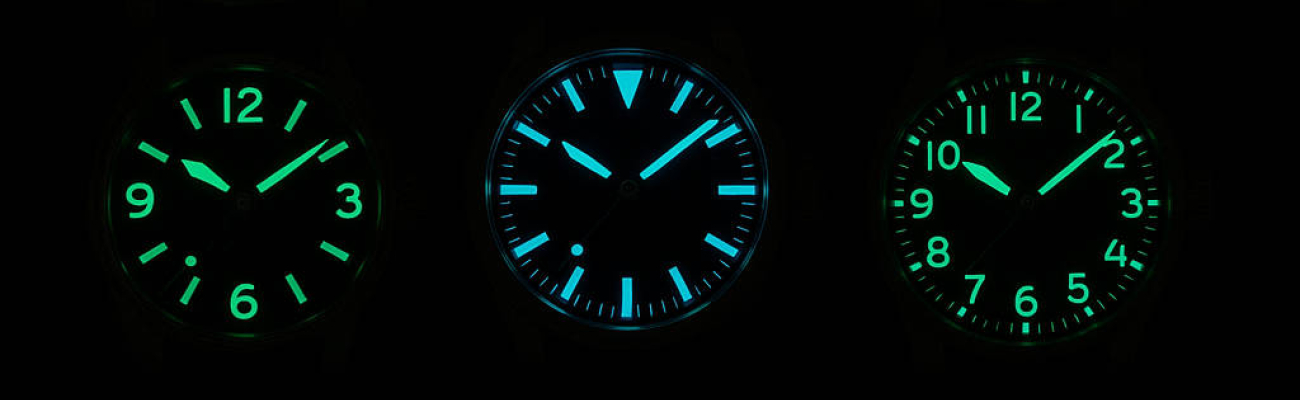
Super-LumiNova is available in a wide spectrum of colors, but the color you choose directly impacts the brightness of the glow. The human eye is most sensitive to green light, which dictates the performance of the most popular lume codes.
- C3 (Green): C3 is the brightest of all Super-LumiNova colors. In daylight, it has a slightly yellowish-green tint. In the dark, it emits a blazing, radioactive-looking green glow. If absolute maximum brightness is your goal, C3 is the undisputed champion.
- BGW9 (Blue-Green/White): BGW9 is incredibly popular in modern luxury watches. In daylight, it appears as a crisp, pure white, which looks fantastic against a black dial. In the dark, it emits a cool, icy blue glow. While it is roughly 5% less bright than C3, many collectors prefer its clean daytime aesthetic.
- Old Radium: Designed specifically for vintage reissues and heritage models, Old Radium lume is dyed to look like aged, patinated Tritium or Radium in the daylight (a warm, creamy orange/brown). In the dark, it typically glows a bright yellowish-green.
Tritium Gas Tubes (GTLS): The Always-On Tactical Choice
While Super-LumiNova is fantastic, it has one fundamental flaw: it requires an external light source to charge. If you keep your watch under a thick winter coat sleeve all day, or if you are operating in a dark environment for 12 hours straight, photoluminescence will eventually fade to black. For military personnel, first responders, and extreme explorers, this is unacceptable.
The solution is Gaseous Tritium Light Sources (GTLS), commonly referred to simply as Tritium tubes. Brands like Ball Watch Co., Luminox, Marathon, Traser, and Vostok Europe rely heavily on this technology.
How Gaseous Tritium Light Sources Work
GTLS technology is a marvel of micro-engineering, primarily manufactured by the Swiss company mb-microtec. The process begins with microscopic, laser-sealed borosilicate glass tubes. The inside of these tubes is coated with a thin layer of phosphor powder. The tubes are then filled with Tritium gas (Hydrogen-3), a mildly radioactive isotope of hydrogen.
As the Tritium gas naturally decays, it emits low-energy beta particles (electrons). These electrons constantly bombard the phosphor coating on the inside of the glass, causing it to glow brilliantly. This process is known as radioluminescence.
The result is a watch dial that glows continuously, 24 hours a day, 7 days a week, without ever needing to be charged by the sun or a flashlight. It is an "always-on" technology.
Is Tritium Safe?
The word "radioactive" often causes panic, but GTLS watches are incredibly safe. The beta particles emitted by Tritium are so weak that they cannot even penetrate the glass tube that contains them, let alone the stainless steel case or the sapphire crystal of the watch. Even if you were to smash the watch with a hammer and break every tube on the dial, the amount of Tritium gas released would dissipate harmlessly into the atmosphere in seconds, posing no threat to human health.
T25 vs. T100: Understanding the Ratings
Because Tritium is a radioactive material, its use in consumer goods is strictly regulated by international law. Tritium watches are categorized by the total amount of radiation they emit, measured in millicuries (mCi).
- T25 Watches: These watches contain a total Tritium content of up to 25 millicuries. This is the standard for most tactical watches. The tubes are typically small and thin, providing excellent legibility in total darkness without being overwhelmingly bright.
- T100 Watches: These watches contain a total Tritium content of up to 100 millicuries. Because the legal limit is four times higher, watchmakers (like Ball and Deep Blue) can use significantly larger, wider, and more numerous "flat" tubes on the dial. T100 watches are noticeably brighter and more vibrant than T25 models, creating a spectacular light show on the wrist.
The Half-Life Factor: Does Tritium Die?
The trade-off for having an "always-on" glow is longevity. Tritium has a radioactive half-life of approximately 12.3 years.
This means that 12.3 years after the watch is manufactured, the gas inside the tubes will be half as radioactive, and the glow will be roughly half as bright. After 25 years, the glow will be very faint, visible only in pitch-black conditions with fully dark-adjusted eyes. Eventually, the tubes will go completely dark. When this happens, the watch must be sent back to the manufacturer (or a specialized service center) to have the dial and hands replaced with fresh GTLS tubes.
Seiko Lumibrite: The Japanese Powerhouse
No discussion of watch luminescence is complete without mentioning the Japanese giant, Seiko, and their proprietary compound: Lumibrite.
The Nemoto Connection
As mentioned earlier, the strontium aluminate technology that powers Super-LumiNova was invented by the Japanese firm Nemoto & Co. In the early 1990s, Seiko partnered closely with Nemoto to develop their own proprietary version of this photoluminescent paint, officially introducing it to the market around 1994.
Because Lumibrite and Super-LumiNova share the same foundational chemistry, they operate on the exact same principles. They are both completely free of radioactive substances, they both act as light batteries, and they both last indefinitely without degrading.
Why Lumibrite is Legendary
If they are chemically similar, why does Lumibrite have such a legendary, cult-like status among watch collectors? The answer lies in Seiko's proprietary mixing formula and their application techniques.
Seiko is famous for applying massive, thick layers of Lumibrite to their professional Prospex dive watches (such as the Seiko Monster, Turtle, and Tuna). Because the brightness and longevity of photoluminescence are directly correlated to the volume and thickness of the paint applied, Seiko watches are renowned for their explosive initial brightness.
If you walk from the bright midday sun into a dimly lit room wearing a Seiko diver, the Lumibrite will glow so fiercely that it can practically cast a shadow. According to Seiko's official data, just 10 minutes of exposure to standard indoor lighting (500 lux) is enough to make Lumibrite glow for 3 to 5 hours in the dark.
Application Techniques: How Lume is Applied to Dials
The performance of Super-LumiNova or Lumibrite is not just about the grade of the paint; it is heavily dependent on how the watchmaker applies it to the dial.
Printed vs. Applied Indices
On entry-level watches, lume is often simply pad-printed directly onto the flat surface of the dial. Because the layer of paint is very thin, the glow will be relatively weak and short-lived.
On luxury watches, watchmakers use applied indices. These are small, three-dimensional metal frames (often made of white gold or polished steel) that are attached to the dial. The watchmaker then fills these frames with liquid luminous paint using a microscopic syringe. The metal frame acts like a swimming pool, allowing the watchmaker to pool a massive, thick layer of lume into the index. The thicker the mass of the pigment, the brighter and longer the watch will glow.
The Sandwich Dial
Pioneered by Panerai in the 1930s, the sandwich dial is the ultimate technique for maximizing photoluminescence. Instead of a single dial, the watch features two separate discs layered on top of each other.
The bottom disc is completely flooded with a massive, uninterrupted layer of Super-LumiNova. The top disc has the numerals and hour markers cut out of it like a stencil. When the top disc is placed over the bottom disc, the lume shines through the cutouts. This allows the watchmaker to use an immense volume of luminous material, resulting in a spectacular, long-lasting glow that applied indices simply cannot match.
Which Lume is Right for Your Collection?
Choosing the right luminous technology ultimately comes down to your lifestyle, your aesthetic preferences, and how you intend to use the watch.
- Choose Super-LumiNova or Lumibrite if: You want a watch that will last a lifetime without ever needing the dial replaced. You prefer the explosive, blazing brightness that occurs right after stepping out of the sun. You are a "desk diver," an office professional, or a recreational scuba diver who only needs intense legibility for a few hours at a time.
- Choose Tritium (GTLS) if: You are a military operator, a first responder, a pilot, or an avid outdoorsman who spends long, uninterrupted hours in total darkness. You value consistent, reliable, "always-on" legibility over explosive initial brightness, and you do not mind sending the watch in for a dial replacement every 15 to 20 years.
Conclusion: Light Up Your Wrist at WatchExclusive
The evolution of watch luminescence is a testament to the relentless innovation of the horological industry. We have transitioned from the deadly, radioactive paints of the early 20th century to the cutting-edge, hyper-efficient photoluminescence of Grade X2 Super-LumiNova and the safe, continuous radioluminescence of Tritium gas tubes.
A watch that glows brilliantly in the dark is more than just a functional tool; it is a source of immense joy for the collector. There is a distinct, childlike fascination in watching a mechanical instrument come to life with a vibrant green or icy blue glow when the lights go out.
At WatchExclusive, we understand the importance of perfect legibility. Whether you are searching for the explosive Lumibrite of a Japanese diver, the refined Grade X1 Super-LumiNova of a Swiss luxury sports watch, or the tactical, always-on Tritium tubes of an extreme expedition instrument, we have the perfect timepiece to light up your collection.
We invite you to explore our meticulously curated selection of premium watches. Discover the science of luminescence, elevate your wristwear, and ensure that you never lose track of time, no matter how dark the night gets. Find your glowing masterpiece at Watch Exclusive today.
References
- CiRCULA Watches. (2024). Super-LumiNova® – and the watch lights up! Retrieved from CiRCULA.
- Monochrome Watches. (2026). The ABCs of Time: How Watch Dials Are Illuminated? Retrieved from Monochrome Watches.
- NITE Watches. (n.d.). What is Tritium Illumination? Is it Safe? Retrieved from NITE Watches.
- RC Tritec AG. (n.d.). Swiss Super-LumiNova® qualities. Retrieved from RC Tritec.
- Seiko Watch Corporation. (n.d.). Lumi Brite Technology. Retrieved from Seiko Watches.
- WatchGecko. (2023). Tritium Watches – Your questions answered here! Retrieved from WatchGecko.
Share this content

