Shopping Cart





How Casio Triple Sensor Technology Changed Survival Watches Forever
By :
F. Nagy -
Categories :
Interesting Watch Facts
Table of contents
keyboard_arrow_down
- Key Takeaways
- The Dawn of the Triple Sensor: A Horological Milestone
- Decoding the Altimeter and Barometer: Predicting the Unpredictable
- The Digital Compass and Thermometer: Navigating the Wild
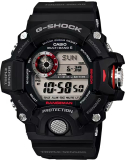
- Casio G-SHOCK Rangeman GW-9400: The Quintessential Survival Tool
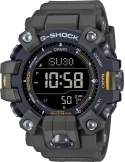
- Casio G-SHOCK Mudman GW-9500: The Next Evolution in Readability
- Beyond the Wilderness: Rugged Alternatives for Everyday Carry
- Why Triple Sensor Watches Remain Essential in the Smartwatch Era
- Equip Yourself for the Next Adventure at WatchExclusive
- References
Key Takeaways
- Revolutionary Miniaturization: The introduction of Casio Triple Sensor Version 3 in 2013 reduced sensor size by 95% and power consumption by 90%, allowing full ABC (Altimeter, Barometer, Compass) functionality to be integrated into shock-resistant G-Shock cases.
- Predictive Weather Tracking: Built-in piezoelectric pressure sensors feature a Barometric Pressure Tendency Alarm, alerting wearers to sudden atmospheric drops that indicate approaching storms.
- Uncompromising Self-Reliance: Unlike smartwatches, Triple Sensor G-Shocks rely on Tough Solar power and internal environmental sensors, ensuring they function indefinitely off the grid without cellular or GPS signals.
- The Ultimate Survival Tools: Models like the Casio G-SHOCK Rangeman GW-9400-1ER and the dual-layer display Casio G-SHOCK Mudman GW-9500-3ER represent the pinnacle of tactical, mud-resistant outdoor horology.
The concept of a survival watch has evolved dramatically over the last century. Initially, a rugged field watch with luminous hands and a water-resistant case was considered the pinnacle of outdoor horology. However, as explorers pushed further into unforgiving environments, the demand for wrist-worn instruments that could actively read the environment became paramount. Enter the era of the ABC watch—Altimeter, Barometer, and Compass. While several brands experimented with these complications, it was the Japanese horological giant Casio that truly democratized and perfected the technology, transforming the wristwatch from a passive timekeeper into an active survival instrument.
The integration of environmental sensors into a shock-resistant, water-resistant module changed the landscape of outdoor gear forever. No longer did hikers, mountaineers, and military personnel need to carry separate, bulky navigational and meteorological instruments. The wrist became a centralized command center for environmental data. This shift was not merely a matter of convenience; in extreme conditions, the ability to instantly access barometric trends or directional headings can be the difference between a successful expedition and a critical emergency. When visibility drops to zero and temperatures plummet, having reliable data at a glance is a literal lifesaver.
At the heart of this revolution is the proprietary Casio Triple Sensor technology. Over decades of relentless research and development, Casio miniaturized complex meteorological and navigational instruments, eventually housing them within the virtually indestructible armor of the G-Shock line. To understand how these timepieces became the ultimate survival tools, we must dissect the engineering behind the sensors, trace their historical evolution, and examine the modern flagship models that continue to set the standard for rugged reliability in the harshest environments on Earth.
The Dawn of the Triple Sensor: A Horological Milestone
Casio's journey into environmental sensors did not begin with the G-Shock. The genesis of the Casio Triple Sensor dates back to 1994 with the release of the ATC-1100, a watch that laid the foundation for the legendary Pro Trek series. According to horological archives, this early iteration was a massive, clunky instrument, but it successfully combined a magnetic compass, a pressure sensor for altitude and weather, and a temperature sensor into a single wearable device. It was a proof of concept that proved highly popular among outdoor enthusiasts, leading to the rebranding of the line as the Pro Trek DPX-500 in 1995.
For years, the Triple Sensor technology remained primarily within the Pro Trek (formerly Pathfinder) domain. The sensors were relatively large and power-hungry, making them difficult to integrate into the heavily armored, shock-absorbing structures required for a G-Shock certification. The thick urethane bezels and floating module designs of G-Shocks left little room for bulky sensor arrays. However, in 2013, Casio achieved a monumental engineering breakthrough with the introduction of Triple Sensor Version 3.
This third-generation technology was a paradigm shift in micro-engineering. As noted by horology experts at G-Central, the Version 3 sensors were an astonishing 95% smaller than their Version 2 predecessors and consumed 90% less power. This drastic reduction in size and energy consumption was the key that finally unlocked the ability to pair ABC functionality with legendary G-Shock durability. Furthermore, the performance metrics were vastly improved: altitude measurements were refined from 5-meter increments down to precise 1-meter increments, and the digital compass could now take continuous readings for 60 seconds, up from a mere 20 seconds. This leap in efficiency and accuracy forever changed the trajectory of survival watches.
Decoding the Altimeter and Barometer: Predicting the Unpredictable
In the realm of wilderness survival, knowledge of impending weather is arguably more critical than knowing the exact time. The barometer and altimeter functions in Casio's Triple Sensor modules operate using a highly sensitive piezoelectric pressure sensor. This microscopic component measures absolute atmospheric pressure, which the watch's internal microcomputer then translates into actionable data for the wearer. Understanding how to read this data is a fundamental skill for any serious outdoorsman.
The barometer typically measures atmospheric pressure in a range of 260 to 1,100 hectopascals (hPa). By plotting these readings on a small dot-matrix graph on the watch face, the user can visualize pressure trends over the past 42 hours. A rising graph indicates improving weather, while a sharp downward curve is a reliable indicator of an approaching low-pressure system, often bringing rain, snow, or severe storms. To make this even more foolproof, modern modules feature a Barometric Pressure Tendency Alarm. When activated, the watch will emit an audible alert and display an arrow indicator if there is a sudden, significant drop or rise in pressure, giving the wearer crucial time to seek shelter before a storm hits.
The altimeter utilizes the exact same pressure sensor but interprets the data differently. Because atmospheric pressure decreases as altitude increases, the watch uses the International Standard Atmosphere (ISA) values to convert pressure readings into an estimated altitude, capable of measuring from -700 to 10,000 meters (-2,300 to 32,800 feet). While this method is highly effective, it is inherently affected by weather changes; a drop in pressure due to a storm can make the watch think you have ascended even if you are standing still. Therefore, seasoned mountaineers know to calibrate their altimeter at known elevation points, such as a trailhead or a marked peak, to ensure pinpoint accuracy during their ascent. The ability to track vertical ascent and descent rates directly from the wrist allows climbers to pace themselves and avoid altitude sickness.
The Digital Compass and Thermometer: Navigating the Wild
When GPS signals fail due to dense canopy cover, deep canyons, or depleted batteries, a magnetic compass becomes a survivalist's most trusted ally. The digital compass in the Casio Triple Sensor Version 3 utilizes a microscopic two-axis magnetic sensor that detects the Earth's magnetic field. When activated, the watch displays the current heading as one of 16 points (e.g., N, NNE, NE) alongside the exact angle in degrees, providing a highly accurate navigational reference.
What makes Casio's implementation particularly robust is the inclusion of a bidirectional calibration and magnetic declination correction feature. True North (geographic north) and Magnetic North (where the compass points) are rarely the same, and the angle of variance—known as declination—changes depending on your location on the globe. By inputting the local declination angle into the watch, the user ensures that the digital compass aligns perfectly with their topographic maps, enabling precise orienteering. The upgraded 60-second continuous measurement allows a hiker to take a bearing on a distant landmark and keep the watch active while navigating toward it, without having to constantly press the button.
The third pillar of the Triple Sensor is the thermometer. Capable of measuring temperatures from -10°C to 60°C (14°F to 140°F), it provides vital data for assessing environmental risks such as frostbite or heat exhaustion. However, horological experts and outdoor guides frequently note a crucial caveat: because the watch sits against the skin, body heat will artificially inflate the temperature reading. To obtain an accurate ambient temperature, the watch must be removed from the wrist and left in the shade for approximately 20 to 30 minutes. Once acclimated, the sensor provides highly accurate meteorological data, completing the watch's capability as a portable weather station.
Casio G-SHOCK Rangeman GW-9400: The Quintessential Survival Tool
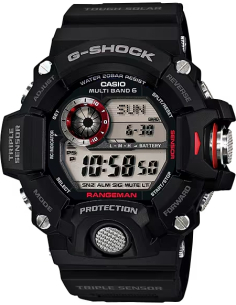
The culmination of Casio's sensor miniaturization efforts arrived in 2013 with a watch that is now considered a modern horological legend. The Casio G-SHOCK Rangeman GW-9400-1ER was the very first G-Shock to feature the Triple Sensor technology. Over a decade later, it remains the benchmark against which all other digital survival watches are measured, beloved by military personnel, first responders, and hardcore survivalists.
Powered by Module 3410, the Rangeman was designed from the ground up for tactical and rescue operations. Its most defining physical characteristic is the cylindrical button guard structure. The main sensor button, located at the 3 o'clock position, is protected by a robust forged metal cover that shields it from lateral impacts and prevents mud or debris from jamming the mechanism. Pressing this single button grants instant, direct access to the compass, barometer, and altimeter. Ingeniously, Casio programmed a distinct audible tone for each sensor mode. As noted in a review by HiConsumption, Each sensor mode has its own audible tone, which means you can determine which mode you are entering without even looking at the watch.
This eyes-free operation is invaluable during nighttime navigation or high-stress rescue scenarios.
Beyond the ABC sensors, the Rangeman is equipped with Tough Solar power and Multi-Band 6 atomic timekeeping. The solar panels embedded in the dial convert even weak fluorescent light into electrical energy, charging a high-capacity battery that can run for up to 23 months in power-saving mode in total darkness. Meanwhile, the Multi-Band 6 receiver automatically syncs the time with atomic clocks via radio waves from six transmitters globally, ensuring split-second accuracy. Furthermore, the watch features a unique time-stamp function that can store up to 40 records of altitude, bearing, and temperature data, allowing users to log their journey's waypoints. For those seeking the ultimate, uncompromising outdoor companion, the Rangeman remains an undisputed champion.
Casio G-SHOCK Mudman GW-9500: The Next Evolution in Readability
While the Rangeman set the standard, Casio's Master of G line continues to evolve, adapting to the feedback of professional adventurers. The latest iteration of the mud-resistant lineage, the Casio G-SHOCK Mudman GW-9500-3ER, takes the Triple Sensor technology and pairs it with a revolutionary display upgrade designed for maximum legibility in harsh conditions.
The standout feature of the GW-9500 is its duplex LCD (dual-layer display). Historically, displaying a digital compass on a standard LCD required sacrificing screen real estate, making the directional pointers small and sometimes difficult to read at a glance while on the move. The duplex LCD solves this by stacking two separate liquid crystal layers. The bottom layer displays the time, altitude, and barometric data in crisp, bold digits, while the top layer is dedicated entirely to a large, cross-shaped compass graphic. When the compass is activated, the directional pointers float above the time display, providing a massive, highly intuitive navigational aid that mimics a traditional analog compass.
In addition to the enhanced display, the Mudman GW-9500 boasts an extreme mud-resistant structure. The front button and three direct sensor buttons are protected by cylindrical stainless steel parts and fitted with internal O-ring seals that completely block out fine sand, mud, and sludge. This makes it the ideal timepiece for jungle treks, desert rallies, or obstacle course racing. Furthermore, Casio has constructed the case, bezel, and urethane band from bio-based resins derived from renewable organic resources like castor oil plants and corn, reducing the environmental impact of the watch without compromising its legendary toughness.
Beyond the Wilderness: Rugged Alternatives for Everyday Carry
While the Triple Sensor models are the undisputed kings of the backcountry, not every watch enthusiast requires a barometer or altimeter for their daily routine. For those who admire the indestructible nature of G-Shock but prefer a slimmer profile for urban environments or everyday carry, Casio offers a vast array of rugged alternatives that still pack a serious punch and carry the same DNA of absolute toughness.
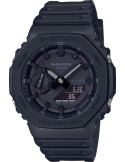
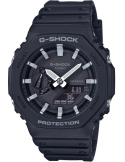
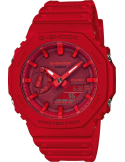
The "CasiOak" series has taken the horological world by storm, blending the brand's legendary durability with a sleek, octagonal bezel reminiscent of high-end luxury sports watches. The Casio G-SHOCK Classic GA-2100-1A1ER and its highly legible sibling, the Casio G-SHOCK Classic GA-2100-1AER, utilize a revolutionary Carbon Core Guard structure. By embedding carbon fiber into the resin case, Casio achieved a profile that is merely 11.8mm thick—the thinnest among G-Shock combination models—while maintaining absolute shock resistance. For those who prefer a pop of color, the Casio G-SHOCK Classic GA-2100-4AER in striking red offers a bold aesthetic statement that stands out in any collection.
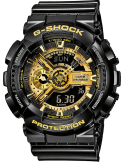
For fans of the oversized, hyper-industrial look that defined G-Shock in the 2010s, the Casio G-SHOCK Classic GA-110GB-1AER remains a staple. Featuring a complex, multi-layered dial with metallic gold accents against a glossy black resin case, it offers magnetic resistance and a 1/1000-second stopwatch. Whether you are exploring the G-Shock collection for a hardcore survival tool or a stylish daily beater, the underlying engineering principles of shock resistance and water resistance remain a constant across the entire lineup.
Why Triple Sensor Watches Remain Essential in the Smartwatch Era
In an age where smartwatches dominate the wrists of many consumers, a common question arises: why rely on a dedicated Triple Sensor watch when a smartwatch can provide GPS mapping, weather apps, and heart rate monitoring? The answer lies in the fundamental principles of survival: autonomy, durability, and absolute reliability.
Smartwatches are inherently dependent on external infrastructure. They require a Bluetooth connection to a smartphone, cellular tower signals for weather updates, and a clear line of sight to GPS satellites for navigation. More critically, their high-resolution screens and constant data processing drain their batteries in a matter of days, if not hours, when using continuous GPS tracking. In a true wilderness survival scenario, or during a prolonged grid-down emergency, a dead smartwatch is nothing more than a useless piece of glass and aluminum strapped to your wrist.
In stark contrast, a watch like the Rangeman or Mudman is entirely self-sufficient. The Casio Triple Sensor gathers its data directly from the immediate physical environment, requiring no cell service or internet connection. The Tough Solar technology ensures that as long as the sun rises, the watch will continue to function indefinitely. Furthermore, the resin cases and mineral crystals are designed to withstand violent impacts, extreme vibrations, deep water immersion, and freezing temperatures that would instantly destroy a delicate smartwatch. As noted by outdoor gear experts at Outside Magazine, dedicated altimeter watches remain the gold standard for mountaineers precisely because they do not fail when conditions are at their worst.
Equip Yourself for the Next Adventure at WatchExclusive
The evolution of Casio's Triple Sensor technology is a testament to the brand's unwavering commitment to utility and resilience. By successfully miniaturizing complex meteorological and navigational instruments and shielding them within the world's toughest watch cases, Casio has provided explorers, military personnel, and outdoor enthusiasts with tools they can trust with their lives. Whether you are tracking barometric drops to avoid a mountain storm or navigating a dense forest using the digital compass, these timepieces offer a level of self-reliance that modern smart devices simply cannot match.
If you are ready to upgrade your outdoor gear and experience the pinnacle of survival horology, we invite you to explore our curated selection of tactical timepieces. Discover the legendary Casio G-SHOCK Rangeman GW-9400-1ER or experience the cutting-edge dual-layer display of the Casio G-SHOCK Mudman GW-9500-3ER. Browse our dedicated G-Shock PRO collection at WatchExclusive to find the perfect companion for your next expedition. Equip yourself with a watch that works as hard as you do, and never step into the wild unprepared.
References
- G-Central: Casio G-Shock Rangeman GW-9400: All Models Released
- HiConsumption: Hands-On Watch Review: Casio G-SHOCK GW9400-1 Rangeman
- Casio Official Archives: GW-9400-1 Product Specifications
- Outside Magazine: Gear Reviews - Altimeter Watches
Share this content