Shopping Cart




Caller vs. Flyer GMT Watches: How to Set and Use Your Travel Timepiece
By :
F. Nagy -
Categories :
Watch Care & Technical Guides
Table of contents
keyboard_arrow_down
- Key Takeaways
- The Anatomy of a GMT Watch
- The Evolution of the GMT Complication
- What is a Flyer (True) GMT?
- What is a Caller (Office) GMT?
- How to Set a Flyer GMT Watch
- How to Set a Caller GMT Watch
- How to Use the Rotating Bezel to Track a Third Time Zone
- Spotlight on the Davosa Ternos Professional GMT
- Exploring the Seiko Presage Collection
- Conclusion: Find Your Perfect Travel Companion
- References
Key Takeaways
- Mechanics Matter: A Flyer GMT features an independently adjustable local hour hand, while a Caller GMT features an independently adjustable 24-hour hand.
- Travel vs. Office: Flyer GMTs are ideal for frequent travelers crossing time zones, whereas Caller GMTs are perfect for tracking remote colleagues or family from home.
- Setting Procedures: Setting a GMT requires a specific sequence to ensure the date complication and 24-hour hand sync correctly with the local time.
- Third Time Zone: Watches equipped with a bi-directional 24-hour bezel can track a third time zone by offsetting the bezel against the GMT hand.
- Accessible Horology: Brands like Davosa and Seiko offer exceptional GMT and travel-inspired timepieces that blend robust mechanics with heritage design.
The world of mechanical watchmaking is filled with complications designed to solve specific, real-world problems. Among these, the GMT (Greenwich Mean Time) complication stands out as one of the most practical and universally beloved. Whether you are a pilot navigating transcontinental flights, a business executive coordinating with international offices, or simply a horology enthusiast fascinated by intricate mechanics, a GMT watch offers a tangible connection to the globalized world.
However, not all GMT watches are created equal. As the popularity of travel watches has surged, a distinct categorization has emerged within the watch community: the Flyer GMT (often referred to as a "True" GMT) and the Caller GMT (also known as an "Office" GMT). While both serve the fundamental purpose of displaying multiple time zones simultaneously, the underlying mechanics and the way you interact with the movement are fundamentally different.
In this comprehensive technical guide, we will demystify the automatic GMT movement. We will explore the horological history behind the complication, break down the mechanical differences between caller and flyer mechanisms, and provide step-by-step instructions on how to properly set your travel timepiece. Along the way, we will highlight exceptional examples of modern watchmaking, featuring the robust Davosa Ternos Professional GMT line and exploring the vintage-inspired elegance of the Seiko Presage collection available at WatchExclusive.
The Anatomy of a GMT Watch
Before diving into the mechanical differences between caller and flyer movements, it is helpful to understand the visual anatomy of a GMT watch. While designs vary wildly from vintage-inspired dress watches to rugged professional divers, most GMTs share a common set of visual cues designed for maximum legibility.
The most prominent feature is, of course, the independent 24-hour hand. To differentiate it from the standard hour, minute, and seconds hands, watchmakers typically design the GMT hand with a large, arrow-shaped tip. It is almost always rendered in a highly contrasting color—such as bright red, orange, or blue—ensuring that the wearer can read the second time zone at a mere glance without confusing it with the local time.
This hand points to a 24-hour scale, which can be located in several places depending on the watch's design. On dressier GMTs, this scale is often printed directly on the dial or on the inner rehaut (the flange between the dial and the crystal). On sports and tool watches, the 24-hour scale is typically engraved into a rotating bezel. To help the wearer quickly distinguish between day and night in the second time zone, these bezels are frequently split into two colors. The top half (18:00 to 06:00) is usually a dark color to represent night, while the bottom half (06:00 to 18:00) is a lighter color to represent day. These two-tone ceramic bezels have spawned affectionate nicknames within the watch community, such as the "Pepsi" (blue and red), the "Coke" (black and red), and the "Batman" (blue and black).
The Evolution of the GMT Complication
To truly appreciate the modern GMT watch, one must look back to the dawn of the jet age. In the early 1950s, the introduction of commercial jet airliners, most notably the Boeing 707, revolutionized global travel. Flights that previously took days were reduced to hours, allowing pilots and passengers to cross multiple time zones in a single day. This rapid travel introduced a new physiological phenomenon: jet lag. It also created a critical logistical problem for pilots who needed to track both their local time and Greenwich Mean Time (GMT), the universal standard for aviation.
While Rolex is often credited with popularizing the GMT watch, the history of tracking multiple time zones in aviation actually predates the GMT-Master. In 1953, Glycine introduced the Airman. Developed after conversations with commercial pilots, the Airman featured a 24-hour dial and a locking 24-hour rotating bezel. However, the Airman was a "purist" 24-hour watch—the main hour hand swept the dial once every 24 hours, rather than the traditional 12 hours. It lacked the dedicated fourth hand that defines the modern GMT complication.
In 1954, Pan American World Airways approached Rolex with a request to develop a watch capable of tracking two time zones simultaneously while reading like a traditional 12-hour timepiece. The result was the legendary Rolex GMT-Master reference 6542. Interestingly, this original model was neither a modern flyer nor a caller GMT. As noted in a historical retrospective by Worn & Wound, the original GMT-Master relied entirely on the friction-fit bezel to provide the second time zone, a brilliantly simple solution to a complex aviation problem.
The 24-hour hand was permanently geared to the 12-hour hand; they could not be adjusted independently.
It was not until 1982, with the introduction of the GMT-Master II (reference 16760), that the modern Flyer GMT was born. This watch featured a new caliber that allowed the local 12-hour hand to jump independently in one-hour increments. Meanwhile, movement manufacturers like ETA developed calibers such as the ETA 2893, which took a different approach by making the 24-hour hand independently adjustable, giving rise to the Caller GMT. Today, these two distinct mechanical philosophies dominate the travel watch landscape.
What is a Flyer (True) GMT?
A Flyer GMT is widely considered the ultimate tool for the frequent traveler. The defining characteristic of a flyer GMT is its independently adjustable local hour hand. When you pull the crown out to the first position, turning it causes the main 12-hour hand to "jump" forward or backward in precise one-hour increments. Crucially, this adjustment happens without stopping the balance wheel or interrupting the sweep of the seconds hand, meaning the watch maintains its precise timekeeping.
From a mechanical standpoint, this is achieved by decoupling the hour wheel from the main gear train via a specialized clutch or jumping mechanism. The date wheel is also mechanically tied to this jumping local hour hand. Therefore, if you land in a new time zone past midnight, jumping the hour hand past 12 o'clock will automatically advance or retard the date.
This functionality is perfect for someone who frequently crosses time zones. When you land in Tokyo or New York, you simply unscrew the crown, jump the local hour hand to the new local time, and push the crown back in. Your 24-hour hand remains untouched, continuing to display your home time (or GMT), and your watch hasn't lost a single second of accuracy. Historically, this complication was reserved for high-end luxury pieces featuring in-house calibers, though recent innovations like the Seiko 6R54 caliber have made the flyer GMT more accessible to a broader audience.
What is a Caller (Office) GMT?
The Caller GMT, conversely, is designed for the individual who remains stationary but needs to track time elsewhere in the world. In a caller GMT movement, the local 12-hour hand is permanently slaved to the minute hand. Instead, the 24-hour GMT hand is independently adjustable. When you pull the crown to the first position, turning it in one direction will jump the 24-hour hand in one-hour increments, while turning it in the opposite direction typically operates the quickset date mechanism.
Mechanically, this is often achieved by adding a GMT module to a standard three-hand movement. The Sellita SW330 and the Seiko 4R34 caliber are prime examples of this architecture. Because the local hour hand cannot be adjusted independently, changing your local time requires pulling the crown to the final position, which hacks (stops) the movement. You must then adjust the time and push the crown back in, re-syncing the watch to a reference time.
While this makes the caller GMT slightly less convenient for frequent travel, it is arguably more useful for daily life. If you work in London but need to coordinate with an office in Hong Kong, you can simply jump the 24-hour hand to Hong Kong time. Your local time remains perfectly accurate, and you can easily see when your colleagues are available. According to an analysis by Fratello Watches, the caller GMT is the unsung hero of the modern international business world, offering a highly practical complication without the premium price tag often associated with true flyer movements.
How to Set a Flyer GMT Watch
Setting a Flyer GMT requires a specific sequence to ensure that the 24-hour hand, the local hour hand, and the date are all perfectly synchronized. Because the date is tied to the local hour hand, there is no traditional quickset date function. Here is the step-by-step process:
1. Hack the Movement: Unscrew the crown and pull it all the way out to the final position (Position 3). This stops the seconds hand. Turn the crown to set the 24-hour hand and the minute hand to your home time (or GMT). Make sure you are setting it to the correct AM/PM time using the 24-hour scale.
2. Set the Local Time and Date: Push the crown in one click to the middle position (Position 2). Now, turn the crown to jump the local 12-hour hand. Rotate it until the date is correct for your current location, and then continue jumping the hour hand until it displays your current local time.
3. Finalize: Push the crown all the way in and screw it down securely to ensure water resistance. Your watch is now set: the main hands show your local time, and the 24-hour hand shows your home time.
How to Set a Caller GMT Watch
Setting a Caller GMT is slightly different, as you have the convenience of a quickset date but must set the local time first. Follow these steps to properly configure your office GMT:
1. Set the Local Time: Unscrew the crown and pull it out to the final position (Position 3), hacking the movement. Turn the crown to set the main hour and minute hands to your current local time. Pay attention to whether you are in AM or PM (you can verify this by advancing the time past 12 o'clock to see if the date changes).
2. Set the Date and GMT Hand: Push the crown in one click to the middle position (Position 2). Turning the crown in one direction will advance the date. Set it to the current date. Turning the crown in the opposite direction will jump the independent 24-hour hand. Set this hand to the time zone you wish to track, reading it against the 24-hour scale on the dial or bezel.
3. Finalize: Push the crown back in and screw it down tightly. Your local time is now displayed on the main hands, and your secondary time zone is tracked by the GMT hand.
How to Use the Rotating Bezel to Track a Third Time Zone
Many GMT watches, particularly those inspired by dive watches or aviation tools, feature a bi-directional rotating bezel engraved with a 24-hour scale. While the dial itself often has a printed 24-hour track, the rotating bezel unlocks the ability to track a third time zone simultaneously.
To do this, you must first have your watch set up normally: local time on the main hands, and home time on the GMT hand (read against the dial's fixed 24-hour track, with the bezel in the neutral triangle-at-12 position). To track a third time zone, you simply calculate the hour difference between your home time and the third location.
For example, if your GMT hand is set to London time (GMT+0), and you want to track Dubai time (GMT+4), you rotate the bezel counter-clockwise by four hours (so the "20" on the bezel aligns with the 12 o'clock marker on the dial). Now, the GMT hand pointing to the bezel will read Dubai time, while the GMT hand pointing to the dial will read London time. This ingenious mechanical trick requires no adjustment of the movement itself, relying purely on the physical offset of the ceramic bezel.
Spotlight on the Davosa Ternos Professional GMT
When discussing high-performance caller GMTs, the Davosa Ternos Professional GMT collection stands out as a benchmark for Swiss-made quality and robust engineering. Built upon the foundation of a professional dive watch, these timepieces seamlessly blend aquatic capability with global travel functionality.
At the heart of these watches beats the DAV 3032 movement. Based on the proven architecture of the Swiss Sellita SW330, this automatic caller GMT caliber operates at a smooth 28,800 vibrations per hour (4Hz) and offers a reliable power reserve. It allows the wearer to independently adjust the 24-hour hand, making it an ideal companion for tracking international markets or staying connected with family abroad.
The build quality of the Ternos Professional GMT is uncompromising. Each model features a substantial stainless steel case with a water resistance rating of 20 ATM (200 meters), a screw-down crown, and a scratch-resistant sapphire crystal with an anti-reflective coating and a date magnifier. The bi-directional rotating bezels are crafted from high-tech ceramic. This material boasts a Vickers hardness of 1250 HV, ensuring it remains impervious to scratches, corrosion, and UV fading. The production of these two-tone ceramic bezels is incredibly elaborate, requiring immense expertise to achieve a seamless transition between colors without bleeding.
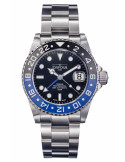
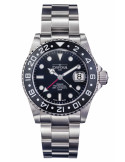
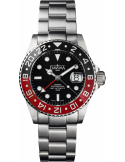
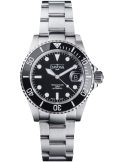
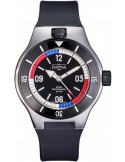
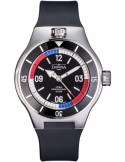
Furthermore, legibility in low-light conditions is guaranteed by the generous application of Super-LumiNova BGW9 on the hands and indices, which emits a bright, long-lasting blue glow. WatchExclusive offers several striking variations of this professional tool watch. The Davosa 161.571.45 Ternos Professional TT GMT automatic Watch features a highly sought-after blue and black ceramic bezel, offering a sleek, modern aesthetic. For those who prefer a warmer, more vintage-inspired color palette, the Davosa 161.571.50 Ternos Professional TT GMT automatic Watch and the Davosa Ternos Professional GMT Automatic 161.571.90 Watch deliver striking black and red bezel configurations. Paired with solid stainless steel Pentalink or Trialink bracelets featuring diver extensions, these watches are as capable over a neoprene wetsuit as they are under a tailored shirt cuff.
Exploring the Seiko Presage Collection
While Swiss brands like Davosa excel in robust, dive-ready GMTs, Japanese watchmaking giant Seiko has taken a different approach, focusing on heritage, dial craftsmanship, and accessible in-house movements. Seiko recently democratized the mechanical travel watch with the introduction of the Seiko 4R34 caliber, a caller GMT movement that has been successfully integrated into the Presage Style60's line.
However, the allure of the Presage collection extends far beyond its GMT offerings. For enthusiasts who appreciate the vintage aesthetic of the Style60's but prefer the clean, uncluttered symmetry of a classic three-hander, Seiko offers exceptional alternatives. Drawing direct inspiration from the 1964 Seiko Crown Chronograph—Japan's first wristwatch with a stopwatch function—the modern Style60's models capture the essence of mid-century horology.
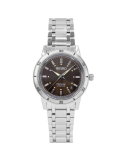
The Seiko Presage SRPL07J1 Watch is a perfect example. Housed in a refined 39.5mm stainless steel case, it features a stunning dark blue sunray dial, a fixed 60-minute bezel, and a box-shaped Hardlex crystal that mimics the acrylic crystals of the 1960s. It is powered by the reliable 4R35 automatic movement, offering hacking seconds and a date complication. Similarly, the Seiko Presage SRPL09J1 Watch delivers the exact same vintage specifications but swaps the blue dial for a rich, warm brown sunray finish, evoking the tones of vintage leather and classic workwear.
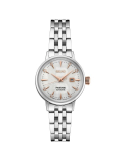
For those seeking a more delicate and luxurious expression of the Presage philosophy, the Cocktail Time series remains unmatched. This collection was originally inspired by the vibrant bar culture of Tokyo's Ginza district, with dial designs created in collaboration with Hisashi Kishi, the head bartender at the famous Star Bar. The Seiko Presage SRE009J1 Watch is a breathtaking ladies' timepiece inspired by the Clover Club cocktail. Measuring an elegant 30.3mm, it features a highly textured mother-of-pearl dial that plays brilliantly with the light, mimicking the frothy foam of a freshly shaken cocktail. This intricate dial is accented by rose gold-tone hands and eight diamond hour markers, elevating the watch into the realm of fine jewelry. Powered by the automatic 2R05 caliber, it proves that serious mechanical watchmaking and high-end aesthetic design can coexist beautifully.
Conclusion: Find Your Perfect Travel Companion
Understanding the mechanical nuances between a Caller GMT and a Flyer GMT is essential for any watch enthusiast looking to add a travel complication to their collection. Whether you require the jumping local hour hand of a flyer for constant jet-setting, or the independent 24-hour hand of a caller for managing global communications from your desk, the GMT remains one of the most romantic and practical complications in horology.
From the deep-sea capability and Swiss precision of the Davosa 161.571.45 Ternos Professional TT GMT automatic Watch to the vintage-inspired charm of the Seiko Presage collection, there is a mechanical masterpiece waiting for every wrist. We invite you to explore our curated selection of GMTs, dive watches, and dress pieces at WatchExclusive, where horological heritage meets modern performance.
References
- Forster, Jack. "The GMT-Master And The GMT-Master II: What's The Difference?" Hodinkee.
- Broer, Robert-Jan. "Caller vs. Flyer GMT Watches: Understanding the Mechanics." Fratello Watches.
- "The History of the Rolex GMT-Master." Worn & Wound.
- Official Technical Specifications, Davosa Swiss Watches.
- Official Caliber Data, Seiko Watch Corporation.
Share this content